

Waste matters
There has been a massive change in the way businesses and
local authorities deal with their waste and how technology
is being used to turn previously unwanted material into a
valuable resource.David Hall, managing director
There has been a massive change in the way businesses and
local authorities deal with their waste and how technology
is being used to turn previously unwanted material into a
valuable resource.David Hall, managing director of
Kenburn Waste Management, explains
When I came into the business in
the early nineties waste
management was a much simpler
task than it is today. We were living in a
throw-away society with little thought given
by the public or businesses to what
happened to ‘rubbish’ after it was thrown
away. Recycling was something we did with
milk bottles and expensive aluminium cans,
but little else.
Large compactors were
used extensively by those
producing large quantities
of waste simply to reduce
the cost of sending it to
landfill; however, the world
was about to change.
Government legislation
such as the landfill tax and
packaging waste directives
introduced in the late
nineties made it
commercially viable to
recycle materials, especially
cardboard, rather than
sending it to landfill.While
packaging waste directives
gave advice to retailers and
manufacturers on how to
reduce the amount of
packaging waste, the
landfill tax hit business owners hard in their
wallets and was by far the
biggest driver in encouraging
them to change their attitude
to waste management.
It just didn’t make sense to
continue sending material
that could be recycled to
landfill; why pay a hefty
penalty for throwing
something away when there
was now a ready market for
it? Baling rather than
compacting became more
attractive as it allowed the
now valuable recyclable
cardboard to be stored and
transported easily, turning
what had been an overhead
into an income stream. Although the market
price for waste cardboard has fluctuated over
the years, it currently has a value of around
£50/t with waste paper faring even better at
around double that figure, depending on
quality. Plastic bottles and containers are the
second biggest commodity, although prices
vary widely between £40 and £250/t
depending on chemical composition and
variables such as cleanliness and colour. Offcuts
from plastic product manufacturing
command some of the highest prices.
Recycling contractors will generally pay a
higher price for baled material than for loose
waste as it reduces their transport and labour
costs. In the case of waste cardboard,
recycling companies often ask for ‘mill sized
bales’, in other words large bales of around
400kg ‘four wire tied’. Although there are no
specific dimensions an ideal load is 24t for a
large curtain-side lorry.
Balers fall into two main categories,
horizontal and vertical, with large generators
of waste card or paper (those producing
more than about 2t/day) usually opting for
the horizontal type. Although more
expensive (£70,000 to £250,000), these
machines, some of which can produce up to
50t of pressure, require less manual labour to
operate, often being fed automatically via a
conveyor and featuring automatic tying and
bale ejection.
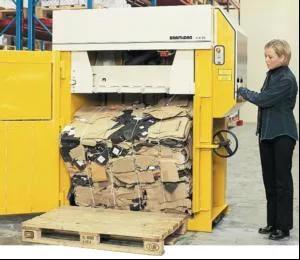
The smaller vertical balers, which typically
cost between £3000 and £15,000 depending
on size, are popular with the retail trade.
While 20 years ago it’s unlikely that smaller
shops would have considered baling, the cost
of sending waste to landfill, currently around
£50/t, has made them an economic
proposition, even without the revenue made
from selling their bales. There are health and
safety issues too. Piles of loose cardboard at
the rear of the premises is no longer
acceptable from an environmental point of
view. Apart from being unsightly there is the
ever-present threat of fire, often caused by
vandals, which could destroy the business
and possibly endanger life. Add to that the
high cost of storing loose cardboard indoors
and the case for investing in baling
equipment is pretty compelling.
I think it’s important to see the acquisition
of baling equipment as an
investment rather than an
overhead. Although the
capital cost can be substantial
the ROI is generally fairly
rapid depending on the
volume of material being
handled.However, with the
increase in demand for balers
over the last few years, the
industry has been blighted by
companies offering cheap,
sub-standard equipment from
dubious overseas
manufacturers. Poor reliability,
low safety standards and often
appalling after-sales support
make these machines an
expensive longer term option.
I know of cases where
machines have been out of
action for days waiting for a
supplier’s sole engineer to fix the problem,
and of machines suffering potentially
dangerous fractures during operation. It
makes better economics to buy a refurbished
machine from a reputable supplier than risk
buying a cheap new one.
When it comes to financing new
equipment we’ve seen a big increase in the
number of machines being leased rather
than purchased outright. Another option is
to rent a machine from a baling supplier.
Often this can be done over short periods
perhaps to cope with a temporary increase in
the volume of waste.With landfill charges set
to rise by £8.00/t year-on-year in an effort to
meet the UK’s recycling targets, the demand
for baling equipment is likely to remain high.
IPE Newsletter
IPE publishes a weekly eNewsletter, delivering a carefully chosen selection of the latest stories straight to your inbox.
Subscribe here