

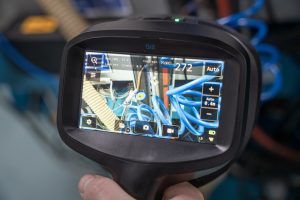
In the picture on energy loss
Thermal imaging is being widely adopted across diverse sectors
to spot and stop energy loss as well as to detect electrical and
mechanical inefficiencies that increase overheads.Andrew
Baker, distributor sales manager of F
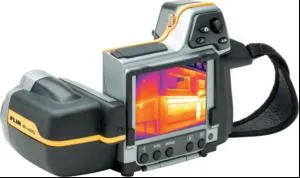
Thermal imaging is being widely adopted across diverse sectors
to spot and stop energy loss as well as to detect electrical and
mechanical inefficiencies that increase overheads.Andrew
Baker, distributor sales manager of FLIR Systems explains
While legislation may be driving
industry’s focus on energy
conservation, the need to optimise
running costs is a priority for many
companies as they strive to become leaner
and fitter. Now more than ever plant and
buildings need to operate with maximum
efficiency and thermal imaging is proving a
suitable technology in this regard.
It is now easily affordable and, thanks to its
application scope, delivers an exceptionally
quick return on investment. It has also
become increasingly easy to apply, allowing
users to do their job quicker
and with greater efficiency.
It’s not just advances in
camera technology that are
responsible for this growth.
Parallel development in PCbased
analysis and reporting
software as well as
application specific software
is becoming increasingly
significant. And it’s the
infrared manufacturers
pursuing all these aspects
that are presenting
industry with the greatest
advantage.
The inclusion of new
communication technology is also playing its
part. For example, a new development allows
portable meters to transfer their
measurement data directly to the infrared
camera via Bluetooth. And this brings much
greater intelligence to the IR environment.
Users can transmit key readings such as
current or voltage from a clamp meter to a
camera making it possible to establish a
relationship between heat and load.
Similarly in the building environment,
when moisture is identified on an infrared
image, an exact reading can be taken by a
moisture meter and psychrometer. Its
readings are then transmitted to the infrared
camera and recorded on the image along
with other readings such as relative humidity
and ambient temperature.
Those involved in building maintenance
were among the first to benefit from the
introduction of sector-specific cameras with
dedicated application functions. As well as a
dew point alarm that detects areas at risk
from condensation, building cameras are
available with a relative humidity alarm that
indicates a site of potential mould build-up.
The same cameras additionally have a builtin
insulation alarm that identifies areas that
don’t fulfil insulation requirements; these
areas are visualised as a coloured isotherm.
The greatest advantage of thermography
however is its breadth of application and even
sector-specific cameras, such as those whose
primary function is building inspection, can
be used to spot general thermal anomalies.
The technology is perfectly suited to a broad
range of electro-mechanical, electrical and
HVAC predictive maintenance tasks that
combine to minimise running costs.
A major benefit in factory management is
an infrared camera’s ability to scan a wide
area in one pass to highlight potential
reliability problems. All kinds of problems
show up thermally for further investigation.
Good examples are overheating connections
and electrical cables or fuse problems; process
valve and pump seal leakage; scale build-up in
pipelines and overheating motor bearings and
windings or misalignment. The technology is
safe and suitable for inspecting outdoor high
voltage switchgear and transformers as well
as low voltage installations. And of course the
target doesn’t need to be excessively hot to
signify inefficient performance. A problem
can also be characterised by an abnormally
cool temperature profile.
The wide-ranging ability of today’s infrared
camera gives it great cost-saving potential. It
is perfectly possible for the same camera to
be used to check a roof for water ingress,
examine the integrity of building insulation,
monitor the efficiency of underground
waterpipes, inspect bearings on a motor,
look for loose terminal connections in a
control cabinet or study a dynamic process.
The return on investment is accelerated with
every application added to the list.
A thermographer at a semiconductor plant
recently described how during his normal
inspection route he discovered a pipe that was
abnormally hot. The pipe ran to the drain,
which seemed unusual.When he followed the
pipe back to it source he discovered that
purified heated water was literally connected
directly to the drain. An improper piping
installation was corrected and an estimated
£60,000 a year saved. The company had
owned infrared camera for just a month and
it had paid for itself several times over.
Thermographers, therefore, should always
be encouraged to be curious!
Related posts
IPE Newsletter
IPE publishes a weekly eNewsletter, delivering a carefully chosen selection of the latest stories straight to your inbox.
Subscribe here