

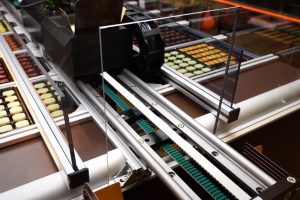
Protected from wear and tear
Piping fresh, clean water through to your tap is a relatively straightforward process for a utility company; the difficulty lies in dealing with the wastewater. Here, Justin Leonard, director at igus, takes a look at how energy chain technologies are being applied in this industry with a number of tangible benefits
It is in sewage treatment plants that wastewater is cleaned so that it can be put back safely into the fresh water supply system, as well as into rivers and oceans. Wastewater treatment is generally a three stage filtration process. At the primary stage, the raw sewage is held in a tank where the heavy solids can settle to the bottom while oil, grease and lighter solids float to the surface. After this, the wastewater is moved to the secondary treatment tank, where dissolved and suspended biological matter is removed. The water is then pumped into the tertiary treatment tank for final filtering before entering back into the ecosystem.
Traditionally these plants require moving power and data cables to feed the gantries across the tanks, as well as dosing lines containing hazardous and corrosive liquids such as sodium hypochlorite. When using cable reeling drums, these cables and hoses often lay unprotected and can be open to the risk of damage due to extremes in weather, which can cause major disruptions to the treatment process.
This was the case at the primary stage of a water treatment plant at Lemuth GmbH in Germany. Here the scraper used to push the wastewater deposit to the bottom of the tank was supplied with power via a cable reeling drum, which lay at the bottom of the tank unprotected. When it was unrolled, it was liable to twist, which contributed to cable damage.
Cables drums are a common sight on tank scrapers, and are often in constant use. With every movement back and forth across the tank, the lack of protection offered by a cable reeling drum can also contribute to increased wear of the outer jacket.
Festoon systems are also used and are a growing source of concern for many sewage treatment companies. Usually used on the tertiary tanks, festoon-cables are unprotected from the elements and tend to hang in loops that can get tangled or caught in the system structure quite easily – especially when it’s windy.
Plastic energy chain systems, such as the igus E2/000 series running within a 'flizz' style enclosed guide trough system, can be used to avoid all of these issues. By enclosing the cables in a robust, flexible chain, they are protected from wear and tear and cannot get caught or tangled at any point. Additionally, the fully-enclosed design of the 'flizz' trough prevents the ingress of dirt and larger debris, as well as protecting the cables from adverse weather conditions.
Suitable for long travels of up to 120m and speeds to 8m/s, the modular energy chain system makes it quick and easy to install and, in case of a fault with a hose, can be quickly dismantled for investigation and repair and then reassembled, minimising downtime. New cables, for example bus cables, can be added to the chain should the sewage plant be undergoing an upgrade to semi- or fully-automated control.
The cables used within any cable management system also have a vital part to play. In multicore cables, the cores are twisted together in layers and in standard cables this twist tends to have a long pitch. This means that when the cable bends, the inner cores are compressed while the outer cores are stretched. After a time, this process can force the cable to take up a corkscrew shape which, in effect, shortens it, and can pull the cores out of their terminations or connectors. The deformed cable may also form loops that get trapped in the moving parts of the scraper, damaging the outer jacket and exposing the core conductors.
The chainflex range, which covers all types of cables from control, motor, servo and measuring cables through to data and bus cables, is guaranteed for 5 million double strokes in constantly moving energy chain applications even at high speeds and accelerations, or in demanding environmental conditions. The new chainflex M range, on the other hand, is designed for less demanding applications where reliability is still important but the required cycle life is much lower.
The chainflex M range has undergone the same demanding in-house tests as standard chainflex for wear, chemical resistance, and flexing performance in energy chains. It is UL/CSA certified, guaranteed to last one million cycles of service life, and costs 20 – 30% less than its standard counterparts.
Unfortunately, the weather is something over which we have no control. But something that utility companies can control is how well their wastewater plants are protected against it.
Related posts
IPE Newsletter
IPE publishes a weekly eNewsletter, delivering a carefully chosen selection of the latest stories straight to your inbox.
Subscribe here