

LED lighting prescribed
To help reduce its lighting related energy spend across 33 sites, private healthcare provider Spire Healthcare has undergone an extensive programme of upgrading 1400 luminaires across 33 sites to light emitting diode (LED) technology.
Firmly established as one of the world’s leading energy performance solutions providers, FES won the original tender and since then has completed two phases of the project.
In order to maximise return on investment (ROI) on the designated capital expenditure (CapEx) budget, the first comprised 21 of the largest energy consuming sites, which achieved in excess of 73 per cent energy savings from a simple point-for-point replacement, while also providing 25 per cent better light output.
The second phase concentrated on 12 further sites and Marcus Brodin, commercial director at FES, comments: ‘We calculated that Spire Healthcare will save in excess of £700,000 over a 10-year period thanks to lower energy costs, reduced maintenance, environmental tax savings related to its inclusion in the CRC Energy Efficiency Scheme, and additional resource savings. The effect on the environment will also be significant as carbon dioxide (CO2) emissions will be reduced by 11,928lbs per annum, mono-nitrogen oxide (NOx) will be lowered by 28lbs and sulphur dioxide (SO2) by 68lbs over the same period – this is the equivalent of four acres of forest being saved or two cars being removed from the road."
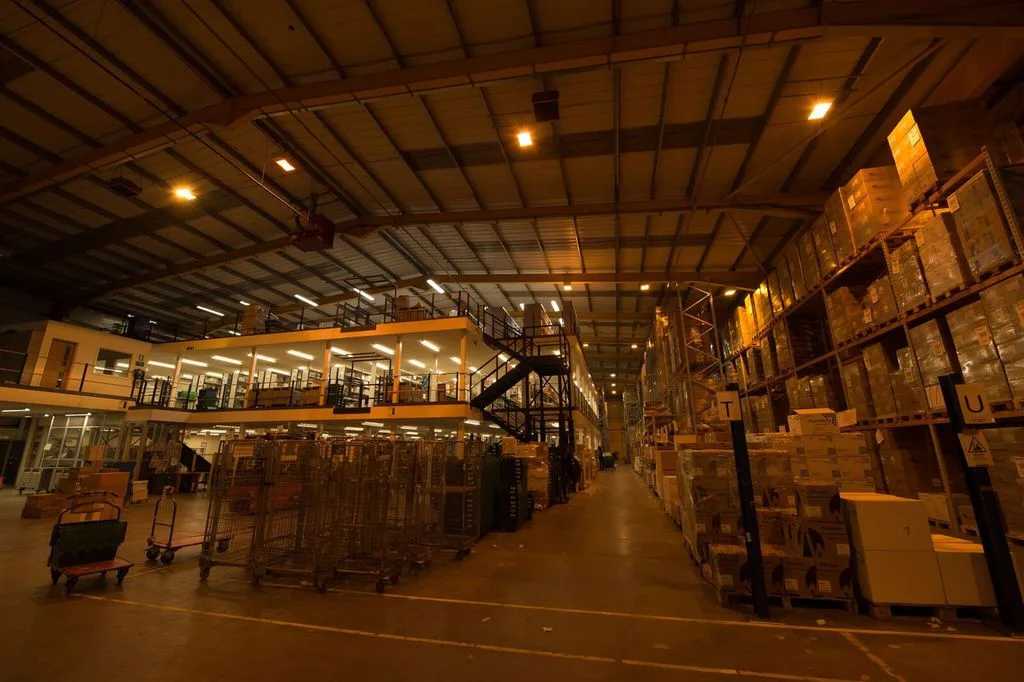
The third phase has recently been completed and this focused on Spire Healthcare’s National Distribution Centre. Based in Droitwich, this 100,000ft² facility provides a platform to procure and supply goods and services to the company on a daily basis through its internal logistics network.
Commenting on the reasons for the change, Brodin says: "The importance of good quality lighting is often overlooked within warehousing and distribution based operations. This should not be the case though, as numerous studies have found that light has a profound effect on our physical and emotional health and wellbeing. Poor lighting can cause eyestrain, migraines and headaches, in addition to lethargy, irritability and poor concentration."
There are no statutory workplace lighting levels in the UK and Regulation 8 of the Workplace (Health, Safety and Welfare) Regulations simply requires that lighting at work is ‘suitable and sufficient’. However, the Health & Safety Executive’s (HSE) Lighting at Work booklet (HSG 38) sets out minimum recommended safe lighting levels and the Chartered Institution of Building Services Engineers’ (CIBSE) offers guidelines regarding light levels required in correlation to workplace activities, stating that warehouses should have 150-200 Lux at floor level and 300 Lux in task areas.
As with the previous phases of the project, FES undertook a comprehensive a feasibility study to scope the objectives and to determine the optimal LED lighting solution for the offices, mezzanine and warehouse areas. It decided to replace 339 116W batten and 400W high bay luminaires with 59W LED battens and 178W high bay luminaires. These state-of-the-art products provide high efficacy of >110lm/W, low luminous decline, excellent colour rendering and unrivalled uniformity.
By incorporating zone based lighting sensors and daylight harvesting, this installation will achieve energy savings of over 75 per cent, with a 732kW saving per day, while providing significantly improved light levels. Also, since the rated life of the new devices are well in excess of the previous luminaires, Spire Healthcare will make a 90 per cent saving on its ongoing maintenance spend. With a 10-year gross energy saving of £338,000, the environment will benefit, with over 1200t of CO2 saved over the duration of the business case.
IPE Newsletter
IPE publishes a weekly eNewsletter, delivering a carefully chosen selection of the latest stories straight to your inbox.
Subscribe here