

Making sure it’s full steam ahead
Many steam systems have the scope to achieve higher
efficiency through improved control, closer monitoring and
more regular maintenance.Paul Mayoh, technical manager
at Spirax Sarco, offers tips on how best to maintain the
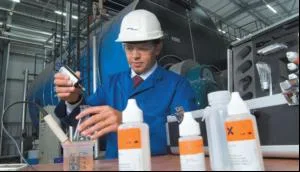
Many steam systems have the scope to achieve higher
efficiency through improved control, closer monitoring and
more regular maintenance.Paul Mayoh, technical manager
at Spirax Sarco, offers tips on how best to maintain the
boiler house to ensure it is running to its full capabili
Steam is an established energy source
for the efficient, reliable production of
hot water and humidification control
for buildings and processes. However, its
inherent reliability can lead to neglect, hiding
the need for regular servicing. The Carbon
Trust estimates that poor operation and
maintenance of industrial boilers wastes up to
10% of the energy input from fuel, while up to
25% of energy is lost through heat distribution
systems and waste at the point of use.
You can improve boiler house efficiency
by taking time to assess how your system is
operating. By ensuring daily maintenance
checks are being carried out and that proper
testing is being done and recorded, you will
improve safety, and may find that savings in
energy, water and treatment chemicals are
there for the taking.
Health check
Check that all statutory daily and weekly
tests of boiler water level alarms are being
performed and recorded properly. Safety is
the first priority here, but routine checks can
often highlight inefficiencies worth tackling.
Regular monitoring of water treatment
records and visible indication in gauge glasses
can often help identify ways of improving
the use of water treatment chemicals and
lead to cost savings. Look particularly for
hardness slippage through the water softener,
contamination of the condensate return, and
correct chemical dosing.
Feedtank conditions
You can improve boiler efficiency by
increasing the temperature of the feedwater,
as less fuel is needed to produce steam from
hot feedwater. For example, using returned
condensate to raise the feedwater temperature
by 6°C gives a fuel saving of 1%. Ideally,
feedwater should be maintained at 90°C.
Adding hot condensate to the boiler feedtank
can reduce the need for preheating, but simply
feeding condensate into the top of the tank can
be inefficient. As condensate falls through the
space above the water, vapour and energy can
be lost and air will be admitted. A deaerator
head can solve the problem by mixing returned
condensate, flash steam and cold make-up
water as they enter the feedwater tank.
Condensate recovery
Returning condensate to the boiler is a
straightforward measure that can save
thousands of pounds per year. Condensate
can contain up to 20% of the energy in the
steam from which it came. Returning water
to the boiler feedtank typically recovers
about half this energy, with the remainder
coming from the flash steam produced as the
condensate pressure drops. Virtually all this
flash steam energy can be recovered by
installing a flash steam vessel or pressurised
condensate return system.
As well as saving energy, condensate
return saves water and treatment chemical
costs. Effluent charges may also be reduced
because less water is discharged to drain.
Automatic blowdown
Using returned condensate as a higher
proportion of the boiler feed means that
the level of contamination in the boiler is
generally lower. However, all boilers need
to be periodically purged by blowdown.
The key to doing this efficiently is to
remove only enough water to maintain
contamination at an acceptable level.
Manually controlled blowdown can be
inefficient, often purging more water than
is necessary to reduce contamination in
the boiler. An automatic TDS (Total
Dissolved Solids) blowdown controller
may be a better option. Continuously
monitoring TDS build-up in the boiler, the
controller opens the blowdown valve only
as required to reduce contamination,
therefore minimising energy losses. Greater
efficiency is achieved by recovering the
heat from the TDS blowdown water as it
flashes to steam. Flash steam can be
separated in a flash vessel and injected into
the boiler feedtank saving both energy and
water.
Good practice
Steam and water meters play an important
role in energy monitoring and targeting
(M&T) schemes. This is especially true
across large sites that include several different
buildings. M&T systems enable plant
managers to break down their sites into
separate cost centres and monitor the
performance of each one separately.
According to a report
prepared for the Carbon
Trust last year, M&T schemes
can yield savings of 10%
across many premises, with
5% considered to be a
conservative average.Many
of these measures won’t
incur any cost, but even
those that require some
investment should pay for
themselves in a matter of
months. After that, the
ongoing benefits will be
reflected directly in your
company’s bottom line.
IPE Newsletter
IPE publishes a weekly eNewsletter, delivering a carefully chosen selection of the latest stories straight to your inbox.
Subscribe here