

Crane choice: It’s horses for courses
It is very important when selecting a crane to consider
factors such as the manufacturing process, safety and
installation needs.Andrew Pimblett, managing director of
Street Crane Company, explains
Overhead cranes are a
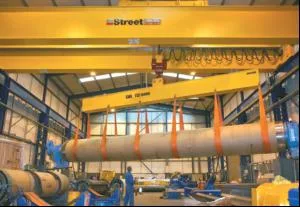
It is very important when selecting a crane to consider
factors such as the manufacturing process, safety and
installation needs.Andrew Pimblett, managing director of
Street Crane Company, explains
Overhead cranes are a
highly flexible
mechanical
handling system, giving you
total access to all parts of the
factory or warehouse while
leaving the floor completely
uncluttered. They are an investment that
lasts – many users will expect a crane to
have a working life of 20 years or more.
Process requirements
Not all overhead cranes are the same. There
are ‘standard’ cranes, but very few standard
applications. Overhead cranes should be
customised for demands placed on them
and considered as an integral part of the
manufacturing process if they are to be
effective at the outset and reliable in the
long run.
Look carefully at the manufacturing
process and factory throughput – both now
and into the future. This will help in
assessing the speeds required in long travel,
cross travel and hoisting. Consider also the
maximum number of daily crane
movements and proportion of lifts and
transfers at the upper end of the crane’s safe
working load (SWL).
This analysis enables the crane maker to
ensure the mechanisms in the crane are
appropriately rated. An over rated crane will
cost more at the outset, but an under rated
crane may prove troublesome and costly,
both in repairs and in the cost of outages.
Safety considerations
The safe working load is declared in bold
numbers on the main crane beam. Even
though cranes are engineered with a margin
of safety, it is important not to exceed this.
Capacity restrictors (overload cut out
devices) are mandatory in EU countries.
Another aspect of crane safety is load
stability. Is the load small and compact or
large and cumbersome? Small compact
loads can be easily handled by a single hoist,
but it may be worthwhile with more
cumbersome loads to consider twin hoist
lifting for additional stability.
Crane speed is another factor in load
stability. If a crane with load accelerates
rapidly the load will initially trail, but if the
crane is then stopped, the load may swing
dangerously. In both cases this could lead to
slippage and dynamic loads are placed on
the crane structure that could be damaging.
These effects can be largely eliminated by
the use of appropriate control technology to
control acceleration and deceleration such
that drag and over swing are virtually
eliminated.
Correct choice of handling equipment is
crucial. Special equipment is available for
the safe handling of steel plate, glass, metal
coils and other difficult to handle products.
There are also a whole range of safety
accessories that can be installed. Strobing
lights and audible alarms are useful on
Goliath cranes to warn of the crane’s
approach. Floodlights are useful on yard
cranes and in sparsely lit plants and
warehouses. Collision prevention systems
are useful where two or more cranes share
the same track.
Practical considerations
There are often practical constraints.Many
modern industrial buildings are only lightly
built. This may preclude the installation of
heavy traditional cranes requiring a track to
be built into the portal frame but a free
standing internal gantry can be installed
within the factory supported on its own
foundations.
New designs of single girder cranes,
portal cranes (Goliath cranes) or semiportal
cranes are also available. The practical
limit for a single girder (mono-rail) crane
was for many years about 15t. New designs
of hoists and beams have extended this
widow and for many applications mono-rail
designs are available up to 25t SWL.
Other concerns may stem from the
factory environment. High ambient
temperature, the presence of dust or
aggressive chemicals may present potential
problems. In all cases there is a solution.
This may involve the resizing of motors to
prevent overheating, introduction of
artificial cooling for control cabinets,
filtration to remove dust or the use of
corrosion resistant finishes.
Maintenance
Modern cranes are designed
to provide long term service
with reliability. However, all
mechanical devices require
periodic servicing. This can
be more rationally planned
where hours-of-use meters
are in use to indicate the
optimum time for
preventative maintenance.
We recommend that
maintenance is conducted
on a planned basis by a
reputable company.
IPE Newsletter
IPE publishes a weekly eNewsletter, delivering a carefully chosen selection of the latest stories straight to your inbox.
Subscribe here