

Absolute feedback systems
According to Balluff, the exact real-time-capable and absolute detection of the current shaft or slide position of modern drive and positioning systems is required for a resource-conserving, energy-efficient and intelligent drive concept with accurate control that increases the productivity, flexibility and energy efficiency of production machines.
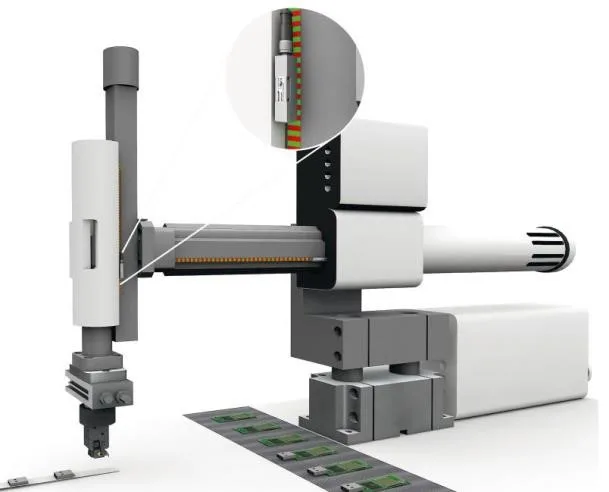
The BML series from Balluff offers rugged, precise and quick absolute position and angle measurement systems as feedback systems, which are suitable for installation or direct integration into drive and positioning systems.
The new, magnetically encoded absolute position and angle measurement systems using Permagnet Nonius technology is said by Balluff to close a gap in the segment of compact, integrative, absolute measurement systems with IP 67 housing for external installation. As an open kit for full integration, they now have the option of being used in rotary applications as well.
Using these systems, the formats, strokes and end positions of axes can be adjusted automatically, quickly and reliably. Their dynamic drive control precisely tuned to the product also ensures an energy-efficient manufacturing process at the maximum number of strokes. Extremely small installation systems in metal housings also have their place in even the tightest installation spaces, while open kits are well suited to individual integration in electric drives.
Why get an incremental system if an absolute system also works?
What they all have in common are the advantages of absolute measurement systems, such as being ready for use immediately at switch-on, no loss of position during unplanned stops and quick start-up even for complicated multi-axis applications. Linear versions of magnetically encoded systems have long been used for monitoring the positions of x, y and z-axes in machine tools or in the direct drives of pick and place automation systems. Many companies use them as a cost-effective, rugged alternative to glass scales. They can also be found in fully electric micro injection molding systems, where they precisely control the injection volume and maintain the pressure level during the plasticizing process. As highly dynamic systems, they are also highly valued in print shops for computer-to-plate processes.
System structure
Magnetically encoded position and angle measurement systems consist of a sensor head and magnetically encoded tape, which is available in both a linear and a rotary version. The sensor head glides over the tape magnetically encoded with alternating polarity at a distance of up to 2mm. Since the systems work magnetically and without any contact, they are able to withstand temperature changes and dirt, such as from dust, oil and wear. Balluff says there are significant differences in the quality of magnetic measurement standards, which is largely determined by the strength and uniformity of the magnetic fields.
Exact measurement
Balluff uses Permagnet Nonius technology. This technology was first used to advance hard drive capacity, where it enabled bits to be packed more densely together. This resulted in a significant increase in storage capacity. The perpendicular arrangement of the north and south poles results in a uniform, concentrated alignment of the elementary magnets. The concentrated alignment of the magnetic fields allows the transitions between the poles to be scanned with extreme precision, which results in high measurement quality. BML systems with Permagnet tape are extremely resistant to interference, feature low hysteresis and have minimal linearity deviation. They are available as absolute and an incremental versions as code discs for rotary movements and in tape form as self-assembling rolled goods up to 48,000mm for linear movements.
The new 'Disc 30' BML encoder kit is a highly accurate, absolute feedback solution for design engineers, which can be integrated easily and directly into motors and actuators. The BML Permagnet Encoder – Feedback is an alternative to conventional magnetic or optical solutions for accurate control of motors and drives. The low space requirement for the solution for rotary applications provides another eye-catching quality; it is just 12 – 20mm in length and 30mm in diameter depending on design.
Another highlight is the air gap of up to 0.5mm between the code disc and electronic processor unit, which is large compared to optical systems. During mass production of motors and actuators, the advantage of this gap is reflected in more flexible, simplified assembly, direct cost savings and competitive advantages. Balluff says, contrary to what some may believe, the moderate installation tolerances and the large distance between the code disc and electronic processor unit (< 0.5 mm) do not have a negative effect on system accuracy. The new solution reaches a system accuracy of < 0.2° at a resolution of up to 17 bits without any difficulty.
A fully integrated, single–chip solution is the core of the magnetic scanning and signal generation process. The position data is generated in real time and made available in absolute form using interfaces typical in drive engineering, SSI or bidirectional BiSS C. Incremental SIN/COS analog signals and ABZ signals are also on hand for use.
BML evaluation kit
In addition to the BML encoder kit, Balluff also offers an evaluation kit. It includes a perpendicularly magnetised Permagnet absolute angle measurement system with high system accuracy. Just like the encoder kit, it offers a variety of serial (absolute) and incremental interfaces for connection to many different closed-loop systems. It is easy to use. Once adapted to the drive, the user can run required system tests to derive a customized, optimized solution using the BiSS-USB adapter and provided evaluation software.
IPE Newsletter
IPE publishes a weekly eNewsletter, delivering a carefully chosen selection of the latest stories straight to your inbox.
Subscribe here