

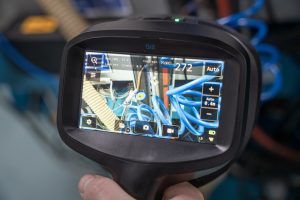
In the picture on gas emissions
Portable thermal imaging has helped transform plant
maintenance and now, says Flir, it is doing the same for the
detection and control of gas emissions
Thermal imaging allows thousands of
components to be scanned in a
Portable thermal imaging has helped transform plant
maintenance and now, says Flir, it is doing the same for the
detection and control of gas emissions
Thermal imaging allows thousands of
components to be scanned in a single
shift without the need to interrupt the
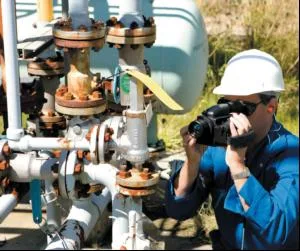
process. Gas leaks are visualised in real time
at a safe distance and the thermal image
reveals not just the results of the leak but
also its source. And by changing lenses the
operator can capture a complete scene or
focus on a small detail.
Thermal imaging can be used to detect a
broad range of greenhouse gases and VOCs.
Carbon monoxide is another gas that is
easily visible with the appropriate camera.
Such is the sensitivity of some models that
even the smallest leaks can be seen and this is
particularly important when looking as gases
such as SF6 that is 24,000 times more
dangerous to the environment than CO2.
The leak appears in real time as a plume
of smoke through the camera’s viewfinder or
LCD. Flir believes a thermal sensitivity of
less than 25mK should be the benchmark
specification for this field of work and some
models also have a high sensitivity mode to
enhance their capability.
At start-up there is no need for any
complicated setting procedure. As cooled
cameras are used for gas detection, they just
need a few moments to cool down to the
required temperature but after that images
are instantly available. No post-processing is
involved and the resultant video footage is
simply played back via a proprietary media
player such as Windows. The information is
therefore easily incorporated into reports,
emailed, shared with colleagues and
archived.
What about cost?
By comparison with sniffer technology,
thermal imaging is a high-end solution.
However, the key aspect here is value for
money and the benefit of thermal imaging is
that it can be used to scan large areas and
even kilometres of pipeline in real time from
a moving vehicle.
Minimising leaks however is not just
about ensuring environmental compliance,
it’s also about containing operating costs.
Thermal imaging is very efficient at
providing the necessary information to
satisfy both requirements.
The latest generation of these cameras
have also introduced another important
capability. They are dual use. As well as
providing thermal images of leaks they are
fully radiometric. This means that the
camera’s infrared technology can be used to
measure the thermal performance of
anything with an operating temperature
above absolute zero.
So, in addition to gas detection, the
camera can also be used for electrical and
mechanical maintenance applications too.
This adds considerable value to the camera
and allows it to provide a swift return on
investment.
Related posts
IPE Newsletter
IPE publishes a weekly eNewsletter, delivering a carefully chosen selection of the latest stories straight to your inbox.
Subscribe here