

Designing tools to cut health risk
For those who use power tools in their day to day work the
subject of health and safety is becoming an increasingly hot
topic with regards to their professional use.Here, Bosch
outlines some of the key issues
Vibratio
For those who use power tools in their day to day work the
subject of health and safety is becoming an increasingly hot
topic with regards to their professional use.Here, Bosch
outlines some of the key issues
Vibration levels, dust, and weight are
increasingly being scrutinised and
power tool manufacturers, such as
Bosch, are keen to produce tools which are at
the forefront of addressing these issues.
Vibration is a major topic in the power
tools industry, even more so since the EU
Physical Agents (Vibration) Directive
2002/44/EC was introduced on 6th of July
2005. This directive has gained legal status
across Europe and has been implemented in
the UK under the Control of Vibration at
Work Regulations 2005.
The directive is primarily aimed at
employers of people who, in the course of
their work, hold objects or work equipment
that transmit vibration into the hand and
arm. The people most at risk are those who
work regularly with high vibration tools such
as grinders and breakers etc. An employer is
therefore called upon to estimate the daily
exposure to vibration of his employees and
to reduce it if it exceeds a certain limit. This
is important because excessive or continuous
exposure to high levels of vibration can lead
to Hand Arm Vibration Syndrome (HAVS).
The most well known form of HAVS is
Vibration White Finger which is one of the
most commonly reported industrial diseases,
and has lead to many claims
for compensation against
employers.
One of the measures an
employer can take is to use
power tools which are low in
vibration. Any power tool that
is hand-held should be as low
in vibration as practicable.
Bosch first addressed the
HAV issue as early as 2001
with the introduction of
‘Vibration Control’ handles
for angle grinders. Its SDSMax
hammer range also
now has vibration reduction
handles and the company strives
to increase the performance of its power tools
and accessories in order to improve
productivity for users, reduce trigger times
and therefore reduce exposure to HAV.
Other risks associated with power tool
usage include exposure to dust. According to
the HSE, work related dust causes the death
of thousands of people every year, and even
more suffer work related breathing or lung
problems. Exposure to dust can come from
many sources, from core drilling through
brick or concrete, cutting tiles, or from
sawdust when woodworking. All dust has the
potential to be harmful, some more so than
others. Considered to be the most risky are:
Asbestos, which poses a major risk to
maintenance workers, plumbers and
electricians, who often don’t know they
are exposed to it
Stone dust, generated by stone, concrete,
slabs and all most other types of masonry,
contains tiny particles called respirable
crystalline silica, a fine, invisible and
highly dangerous dust particle
Wood dust, generated from materials such
as soft and hard wood, MDF, chipboard
when it is sawn, sanded, drilled into or
routed.
A combination of the increasing awareness
of dust as a risk, legal requirements becoming
stricter and the growing importance of worker
health have led to power tool manufacturers
investing in dust extraction solutions.
At the end of 2009, for example, Bosch
launched a 2-speed impact drill, designed to
extract dust at the point of drilling. The GSB
19-2 REA Professional has integrated dust
extraction in the form of a removable microfilter
system. This system collects even the
finest dust directly at the drilled hole without
the operator having to use an external dust
extraction device. The dust extraction unit
can then be emptied without the need for
additional tools. Since then, Bosch has added
the GBH 2-23 REA professional SDS+ drill
with the same micro-filter system as part of a
larger dust control program of tools,
including professional sanders.
One other area that power tool
manufacturers are addressing in product
design and which also has a direct affect on
health and safety is the weight of tools. As
with the entire technology sector, there is a
growing trend for products to become
smaller and lighter. For power tools, this also
makes them safer to use because the physical
demands on the user are less.
This trend has seen a huge increase in the
number of cordless power tools which use
lithium-ion technology in their batteries.
These batteries are smaller and lighter than
their predecessors yet are high performance.
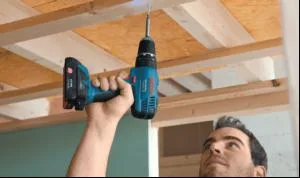
Products such as the Bosch GSB 18-2-LI
Professional light-size combi drill come with
compact lithium-ion batteries. Bosch believes
the drill to be the lowest weight combi drill
on the market. This, combined with a short
compact body and slim grip, make it suitable
for overhead work, offering good balance
and low fatigue for the user.
As health and safety issues remain at the
top of the agenda, so manufacturers of
power tools will continue to anticipate the
effect new regulations will have on product
development, and design tools that can be
used in the day-to-day working environment
while reducing the risk to those who use them.
IPE Newsletter
IPE publishes a weekly eNewsletter, delivering a carefully chosen selection of the latest stories straight to your inbox.
Subscribe here