

The next level of digitalisation
Higher productivity (#higherproductivity) was the focus of Festo’s International Press Conference held in Barcelona, Spain in December 2019. Manufacturing Matters Ireland was there, Georgina Bisby shares some highlights of the event.
Opening the two day event, Oliver Jung, Chairman of the Management Board, Festo, set the scene by explaining how the marriage of Festo’s expertise in industrial applications with latest information technology advancements is facilitating industrial transformation.
As Artifical Intelligence becomes a mainstay of industrial operation, Oliver Jung explained how Festo is accompanying its customers on the digital customer journey from the aquisition of information and configuration through ordering and delivery up to commissioning and maintenance.
Festo is focusing on transferring its core competence of factory automation to the AI-supported, digitalised production of tomorrow. Today, algorithms analyse the data from machinery and provide forecasts of failures or prevent them from occurring. Tomorrow, algorithms will monitor, control, navigate, supervise and regulate value flows in a complex network. While they will not replace decisions by humans, they will support them in their decision-making.
Jung, explained how the classic automation pyramid, with a linear connection between the production and corporate levels, is dissolving and is now orienting its structure towards networked, synchronised production. At the same time, digitalisation is generating virtual twins of machinery, systems and value flows. The great advantage here is that processes, parameterisations and configurations can be acted out in these computer-generated simulations without the need to intervene in existing production processes. Setting-up time and downtime are reduced. This saves costs and time – which is crucial for countries with a high labour content in manufacturing costs, so that they can remain competitive on the global market.
"High productivity due to full automation makes stockpiling of many spare parts necessary, for example, and gives rise to high personnel costs in preventive maintenance. AI, and here in particular machine learning with anomaly recognition, will help reduce these costs in future," says Jung.
As an innovation leader in factory and process automation, Festo always focuses on people in addition to technical solutions and sees the role of technical education and training as crucial both to technological innovation and to promotion of the labour market.
On this subject Xavier Segura, Head of General Management Festo Spain/Portugal focussed on Leadership in the era of Industry 4.0 and considered the challenges and opportunities around bringing employees into Industry 4.0.
One of the greatest hurdles to overcome, according to Xavier, will be for employees to get to grips with the exponential development of technology; “Current projections are that technology will be thirty two times more advanced within five years, a million times more advanced in twenty years and a billion times more advanced in thirty years,” explained Xavier.
However rather than advances in technology resulting in job losses, Xavier said developments will create new jobs. With this will come demand for competences in new areas which will require a commitment to life long learning – something Festo has always actively promoted. Xavier explained: “By 2030 “75 -375 million works will switch occupational categories; All workers will need to adapt to their evolving occupations and 15% to 1/3 of current work activities could be displaced.” Skills of the future are likely to include: Applying expertise; Interacting with stakeholders; Leading people; Unpredictable physical; Processing data; Collecting data and Predictable physical.
Xavier stressed that ultimately, success in this new era will not depend just on technology or processes – but it will rely on effective leadership and how people with creative ideas use technology.
Xavier also discussed how customer expectations are changing as demand for hyper-personalisation and a fast and flexible service grow, all of which must be delivered against the back drop of the urgent need to reduce emissions and foster a move to a more sustainable and ultimately circular economy.
Presenting the Bionic Soft Hand
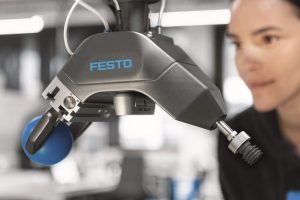
Another highlight of the event was the presentation of Festo’s Bionic Soft Hand, a pneumatic robot hand with artificial intelligence. Karoline von Hдfen, Head of Corporate Bionic Projects demonstrated the innovation, which features a gripper that is modelled on a natural model and can learn through artificial intelligence to solve a wide variety of gripping and turning tasks.
The BionicSoftHand uses the method of reinforcement learning – learning by strengthening. This means that instead of having to imitate a concrete action, the hand is merely given a goal. It tries to achieve this through trial and error. Based on the positive and negative feedback received, the hand gradually optimises its actions until it finally solves the task successfully.
Specifically, the BionicSoftHand should rotate a 12-sided cube so that a previously defined side points upwards at the end. The necessary movement strategy is taught in a virtual environment with the aid of a digital twin, which is created with the help of data from a depth-sensing camera and the algorithms of artificial intelligence.
Artificial Intelligence insight
Tanja Maaß delivered an insightful seminar about bringing artificial intelligence directly to machines. Tanja is Managing Director of Resolto Informatik GmbH, a software developer which became a member of the Festo group in May 2018. Resolto provides solutions that can help with tasks including: predictive maintenance; predictive quality; peak load forecasts; intelligent energy optimisation and early anomaly detection.
Up to now, industrial applications of artificial intelligence (AI) have suffered from latency periods and the high quantities of data involved in connecting to the cloud. “The crucial factor is therefore bringing AI directly to the machine and interpreting data there – directly at the source – in real time,” explained Tanja.
Elucidating on how Artificial Intelligence works in an industrial machine context Tanja likened it to human behaviour. “Unlike condition monitoring, existing errors and anomalies are not programmed in – a healthy behaviour pattern is learnt.
“You want to teach your newborn the perfect life, so all inputs are perfect, no harsh words, lots of love…. And the child learns healthy behaviour at home.
“Then the child goes to nursery and some ’trouble’ is introduced. The child comes home with a bleeding nose because someone punched them.
“At this point you give feedback (human feedback into the algorithm) to see whether this is a healthy state.
“The event is identified as an anomaly, which can be categorised, given a name, and given an action if appropriate,” explained Tanja.
Digital maintenance
Keen to demonstrate how Festo is “drinking its own Champagne” when it comes to digitalisation Michael Hoffmeister, senior expert in digitisation and Industry 4.0, shared details of Festo’s “Smartenance” program and how in the space of just a few years, the use of digital maintenance has become the norm within Festo production
Smartenance is an internally developed digital maintenance manager for production supervisors and plant operators that enables paperless maintenance management across several of its plants. The Smartenance app provides clear scheduling and evaluation tools for plant maintenance and is a quick and easy entrance for small end-users to digital maintenance.
The smart maintenance approach consists of two parts: a mobile maintenance calendar as an app for smartphones and tablets on the shop floor and a web browser interface for managing and documenting maintenance tasks in the office. Intelligent resource management and team collaboration makes maintenance management more efficient.
3D printing in action
On the second day of the event journalists took part in a guided tour of the HP 3D Printing and Digital Manufacturing Center of Excellence, based in Barcelona and saw 3D printing in action. Festo has been working with HP to develop new 3D printers for mass production. Festo is one of HP’s trusted suppliers but Festo is also leveraging the advanced capabilities of HP's Jet Fusion 3D Printing Solutions to speed up its time to market and take advantage of pioneering economic features demonstrating the importance of collaboration in the journey to higher productivity.
Related posts

IPE Newsletter
IPE publishes a weekly eNewsletter, delivering a carefully chosen selection of the latest stories straight to your inbox.
Subscribe here