


Thorough examination: Widespread confusion
The requirement to subject all lifting equipment to periodic
thorough examination is one of the key elements of the
Lifting Operations and Lifting Equipment Regulations
(LOLER).However, Geoff Holden, CE of the Lifting Equi

The requirement to subject all lifting equipment to periodic
thorough examination is one of the key elements of the
Lifting Operations and Lifting Equipment Regulations
(LOLER).However, Geoff Holden, CE of the Lifting Equipment
Engineers Association (LEEA), says confusion exists about
how employers should go about meeting their obligation
The best starting point for guidance is
the Approved Code of Practice that
accompanies LOLER, and LEEA’s
long-established Code of Practice for the
Safe Use of Lifting Equipment (COPSULE).
Both stress that, under LOLER, lifting
equipment is taken to include any
equipment that is used at work for lifting or
lowering loads, including attachments used
for anchoring, fixing or supporting them. It
therefore covers a diverse array of
equipment, including shackles, slings and
load lifting attachments. All are covered by
the requirements for thorough examination.
LOLER details when a thorough
examination should take place. However,
employers are often unclear as to what it
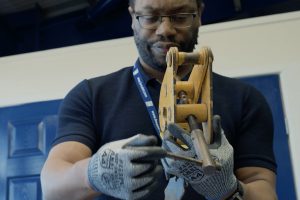
actually involves. COPSULE’s definition is ‘a
visual examination, carried out by a
competent person carefully and critically
and, where appropriate, supplemented by
other means such as measurement and
testing, in order to check whether the
equipment is safe to use.’
There is similar confusion over what
constitutes a ‘competent person.’ It is perhaps
best defined as a combination of technical
knowledge of the equipment to be inspected,
and the ability to put that knowledge into
practice. The LEEA’s well established
Diploma programme provides an industryrecognised
qualification and the Association
now issues a ‘TEAM’ (Test, Examine And
Maintain) identity card to engineers that
have passed the Diploma examination, along
with a logbook that details any relevant
practical experience.
In many workplaces, simply keeping track
of lifting equipment is a challenge. Every
item must have an individual ID. Hard
stamping is commonly used, but can cause
problems on smaller items. Alternatives
include colour-coded tags and, increasingly,
RFID products which offer the ability to
embed additional information and
documentation. In all but the smallest
operations, a central store and formal
control and issue system is advisable.
While thorough examination is an
important process, employers should never
rely on it exclusively to ensure equipment
remains fit-for-purpose. Lifting equipment
often leads an arduous life. Accidental
damage, corrosion, and attack by heat or
chemicals are commonplace. Equipment
should therefore also be subject to regular
‘in-service inspection’ by trained staff.
Typically this will not be a time-consuming
task – a quick visual process and perhaps a
simple operational test. However, those
responsible must have the judgement and
authority necessary to withdraw from service
any item that poses a risk to health and
safety. Failure to do so can have lethal
consequences.
Related posts

IPE Newsletter
IPE publishes a weekly eNewsletter, delivering a carefully chosen selection of the latest stories straight to your inbox.
Subscribe here