

Lean approach
Many companies now follow lean manufacturing principles,
adopting more streamlined processes.This has affected the
way storage systems are specified and used to provide
optimum benefits.Here Clive Woodward, group managing
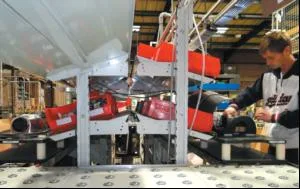
Many companies now follow lean manufacturing principles,
adopting more streamlined processes.This has affected the
way storage systems are specified and used to provide
optimum benefits.Here Clive Woodward, group managing
director of bott, explains
Organisations used to look at storage
as a solution to help keep the
working environment tidy. It didn’t
always work, as anecdotal evidence suggests
workers would often leave tools and essential
equipment lying around or fail to top-up
supplies. Today however, many businesses
have switched on to using storage in a more
efficient and productive way as ‘lean’
becomes the principle adopted in many
manufacturing environments.
The concept of ‘lean’ is not just restricted
to the manufacturing process but applies to
an entire organisation, including supply
chain, product development
and service. ‘Lean’ encourages
businesses to eliminate waste
by minimising inventory and
reducing processes that do
not add value to the end
product. As a result lean
manufacturing has changed
how storage is integrated
into the industrial
environment.
Using lean techniques
can mean less storage with
greater use of logistics and
a dedicated workforce who
buy into the importance of
accuracy and quality – the
‘right first time’ philosophy. Unlike
traditional manufacturing methods, the
‘lean’ approach requires greater organisation
and a focus on optimised process to
eliminate non-essential activities, tasks and
materials – streamlined operations.
When supplies come in, they must be
quickly sorted, checked-in and accurately
placed in appropriate storage, often at lineside.
Storage accuracy is key so no time is
wasted looking for misplaced products or
tools. In a lean scenario, only necessary
stocks are held. The lean approach focuses
on identifying and efficiently locating fastturnover
consumables, which helps to ensure
that staff always have easy access to the right
parts and don’t run out. Every business will
have some items that move faster than
others, so products can be organised in such
a way to ensure it is possible to identify those
which fall below agreed safety stock levels,
and they can be placed in the most
convenient positions.
Equally equipment, tools and
measurement devices need to be to hand and
stored to allow rapid retrieval, while being
protected/secured to avoid unplanned
repairs/recalibrations and prevent theft.
There is no set rule for how storage should
be integrated into the working environment.
It is more a case of identifying the way each
business operates and looking for the storage
solutions that will complement defined
processes. There are however lean tools that
can help companies make the right decisions.
For example, through flow process analysis
which involves mapping out how a production
line should operate and looking at the
current work stations, it is possible to balance
work flow. It isn’t productive for one or two
employees in a five station process to be
taking longer to complete their part of the
job, causing a bottleneck. By assessing the
detail of the work for each person, work
stations can be designed around specific
needs to improve efficiency and line balance.
One of the seven wastes listed in the
principles of ‘lean’ is SMED (single minute
exchange of die); the idea is to get the
quickest tool change possible to achieve the
longest working time on the machine.
Having storage that is organised, easily
accessed and perfectly suited to the job
reduces downtime for machine and operator.
Tools and components must be readily at
hand and easily identifiable – a fundamental
lean principle. Critical items tagged with
RFID readable labels can aid easy location.
Mobile storage is growing in popularity, as
workers avoid the need to go off to locate
tools for each task and instead take tools
with them as they move around the plant.
Having storage specifically assigned to an
individual makes it easier for them to find
the tools and equipment they need.
As well as being specified to fit operational
workflows, storage should help businesses
get the most out of available floor space. This
means not just looking at the physical sizes
of drawers and cupboards, but how they are
located and integrated. For example, where
access is an issue, units with roller shutter
doors, provide a viable option for users to
access a cupboard’s contents where there isn’t
sufficient room to open doors.
Whether wall storage, tool boxes,
workbenches, cupboards, cabinets, trollies or
assembly lines, bott has solutions within its
range to suit almost all storage requirements.
In addition it offers storage with intelligent
locking, which is suitable for valuable,
sensitive or specifically calibrated tooling.
Access is restricted so the item should never
go missing and will be fit-for-purpose as it’s
only available to certain users within preconfigured
calibration time-frames.
Lean is a mentality adopted by an
organisation and in which storage can play a
part. When looking at ways to improve
operational workflow, reduce footprint of
equipment and increase the workforce’s
output, consideration must be given to
selecting the correct form of storage due to
the commercial benefits it can offer.
IPE Newsletter
IPE publishes a weekly eNewsletter, delivering a carefully chosen selection of the latest stories straight to your inbox.
Subscribe here