

Coating cuts glass
Fragment retention lamp coatings have been available for
a number of years, but it was only in 2010 that regulations
came into force defining lamp life, coating protection and
lamp performance. Chris Payne from GlassGuard
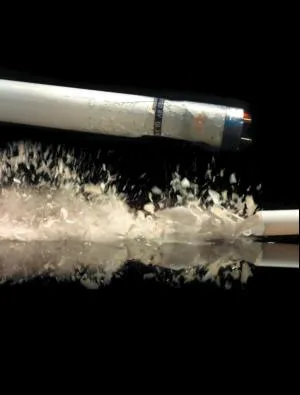
Fragment retention lamp coatings have been available for
a number of years, but it was only in 2010 that regulations
came into force defining lamp life, coating protection and
lamp performance. Chris Payne from GlassGuard explains
why such coatings are an important step forward in
industrial safety and cites a recent case study
Glass is one of the most dangerous
potential contaminants, but with
fluorescent lamps in factories,
packaging plants, public buildings and even
as component parts in machinery, shattered
glass can be common and sometimes go
undetected. Diffusers are used in most
situations to prevent contamination from
lamps shattering unexpectedly, but simple
lamp maintenance times are the most
dangerous for glass contamination. As soon
as the diffuser is removed to change a lamp,
glass is exposed and at risk.When accidentally
dropped or smashed a standard fluorescent
tube can cause widespread glass contamination
or personal injury with potential costs
running into tens of thousands.
An industry-compliant fluoro polymer
coating retains glass shards in the event of
breakage, offering protection from the point
of installation through useful life without
any degradation, and is an easy way to
comply with HACCP and other standards.
Raising standards
Fragment retention lamp coatings have been
available for a number of years now, but it
was only in 2010 that strict regulations came
into force defining lamp life, coating
protection and lamp performance. Every
industrial facility should be aware of the new
BS EN61549 standard, which requires that all
fluorescent lamps should meet a 4m impact
test and successfully retain all fragments. It
also requires that the safety coating must
remain active for a minimum of 8000h lamp
life and withstand a 650° Celsius glow wire
test.With a number of different shatterproof
lamps available on the market, this standard
represents an important step forward in the
improvement of safety and offers reassurance
to users that glass contamination will no
longer be a worry.
All shatterproof fluorescent lamps that
have a BlackBand ring at one end comply
with BS EN61549.While some other lamps
only offer 5000h burning life, the industrycompliant
GlassGuard BlackBand fluoro
polymer coated lamps offer 20,000h. That is
an extra four times the service life and 100%
glass fragment retention.
Chris Payne believes GlassGuard
BlackBand coated lamps are important for a
variety of businesses. In today’s tough
economic climate, industrial facilities, for
example, cannot afford down time to
machinery while broken glass is cleaned up.
Case Study
Having recently switched to GlassGuard
BlackBand fragment retention lamps, Dale
Blunt, engineering manager at the Arla
Foods milk processing facility in Ashby de la
Zouch, explains how the change has
impacted on the plant.
“We had issues in the past inside one of
the filler cabinets where a light fitting
exploded and we weren’t at the time using
the GlassGuard BlackBand shatterproof
tubes.We had to have the filler down for 12h
to do a really thorough clean, just to make
sure that there was no possibility of
contamination.
“Just off that single filler, the down time
period was about a £12,000 to £14,000 loss
in production. By using the GlassGuard
BlackBand fluorescent tubes, that risk is
taken away completely.
“The tubes, even in accidents, contain the
glass within an outer coating, so from a
product contamination point of view, for us,
it’s essential that we use them. Even though
we’ve got diffusers fitted, when we’re doing a
lamp change the exposure and risk is
significantly higher to the product, so by
using the coated tubes the risk is reduced to
the point where it is controlled.
We are audited on a regular basis,
externally by the customers, who recognise
the BlackBand on the glassGuard tubes and
for us to use to show that we are exceeding
the standard required in the milk industry at
present.”
IPE Newsletter
IPE publishes a weekly eNewsletter, delivering a carefully chosen selection of the latest stories straight to your inbox.
Subscribe here