

Pump up efficiency
The latest condition monitoring equipment and techniques
can help prolong the operating life of water and wastewater
pumps. Phil Burge of SKF, explains
Vibration caused by the wear of
components or the misalignment
a
The latest condition monitoring equipment and techniques
can help prolong the operating life of water and wastewater
pumps. Phil Burge of SKF, explains
Vibration caused by the wear of
components or the misalignment
and balancing of rotating shafts is a
common problem with water and wastewater
pumps, leading to an increase in energy
consumption, higher maintenance costs and,
in extreme cases, to catastrophic failure.
Condition monitoring equipment, such as
accelerometers, is widely used and has often
proved to be the most effective method of
detecting vibration and increasing
temperatures. These devices can form a
fundamental element of holistic predictive
maintenance programmes, which can provide
early warning of a change in operating
conditions, allowing remedial action to be
taken before any significant damage is done.
Driven by its increasing adoption as part
of plant-wide management programmes,
condition monitoring technology, including
both vibration detection and thermal
imaging devices, has developed steadily in
recent years. The latest systems now offer
greater speed, simplicity and sophistication
of analysis, with extremely high levels of
accuracy.Moreover, portable and handheld
devices are now smaller, more powerful and
feature far better displays than before, while
providing wireless connectivity to networks
for remote interrogation and control,
providing a wealth of data that can be used
for both short term maintenance planning
and long term plant cost control.
The latest sensors and accelerometers used
for vibration monitoring exploit piezoelectric
and piezoceramic technology and provide a
reliable method of measuring high and low
frequencies, with low hysteresis characteristics
and accuracy over a wide temperature range.
They can be packaged within compact stainless
steel housings to protect against ingress of
moisture, dust, oils and other contaminants.
Mounted in key locations on the
equipment to be monitored, the sensors and
accelerometers allow output data to be read
periodically using sophisticated handheld
data collection instruments, for immediate
analysis or subsequent downloading to a PC,
or being routed via switch boxes to a
centralised or higher level system for
continuous monitoring.
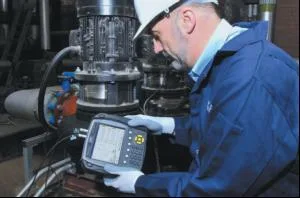
The latest handheld devices are also
simplifying maintenance, ensuring that
machinery continues to operate at optimum
performance to minimise costs. For example,
the easy-to-use and ergonomic family of SKF
Microlog portable data collectors and analysers
automatically collect vibration signals and
static process variables, as well as bearing
assessments, from a wide range of sources,
including handheld and magnetically mounted
accelerometers, permanently mounted
vibration sensors or online monitoring
systems. Temperature measurements can be
collected with non-contact IR sensors or
with a contact probe to check bearing
temperatures for abnormal heat loads that
could indicate lubrication problems.
The SKF Microlog Analyser AX, for
example, can be customised to meet the
needs of individual applications, allowing the
time required for equipment monitoring
rounds to be cut. Users can select from a
range of application modules, creating a
custom device.Modules can be added as
needs develop, keeping ongoing costs down,
and can include balancing, bump analysis,
recorder, frequency response function, run
up/coast down, and check to conformance.
This range of modules enables users to
perform several advanced tasks with a single
device, including impact tests, digital
recording, modal analysis, transient
phenomena analysis and quality inspections.
The device incorporates an 806 MHz
Xscale processor to provide real time rate
and display updates, which can be viewed
clearly on the instrument’s 6.4in VGA colour
display. As with all SKF Microlog products,
the Analyser AX features SKF Enveloped
Acceleration (gE) technology to evaluate
readings alongside established bearing
vibration guidelines, while offering 4-channel
non-route, 2-channel or simultaneous
triaxial route analysis and 2-channel
balancing. The IP-65 rated, dust and waterproof
analysers are constructed to withstand
demanding environmental conditions.
The latest field mounted, wireless condition
monitoring measuring devices, such as the
SKF Multilog WMx, have been developed to
form one of the key components in advanced
condition monitoring systems, collecting
acceleration, velocity, displacement
temperature and bearing condition data.
Typically, this is automatically uploaded for
fast, simple data analysis in a condition
monitoring software suite. Furthermore, they
are suitable for monitoring hazardous,
remote or hard-to-access areas as they do not
rely on wires or cables.
Powerful software tools improve data
collection and analysis, helping realise the
benefits of the latest condition monitoring
instruments. SKF’s @ptitude platform, for
example, enables users to view and analyse
detailed information on the condition of the
equipment, as well as communicating it
throughout an operation. Users have access
to online information and periodic results
against which to compare the recorded data.
The automated process identifies the
probability of specific faults within the
machine before prescribing remedial action.
Once corrective work is complete, it is vital
to continue to monitor conditions to identify
areas for improvement in terms of machine
performance, energy efficiency or output. This
becomes a continuous process of machine
optimisation using a database of statistics
and readings gathered over time.
IPE Newsletter
IPE publishes a weekly eNewsletter, delivering a carefully chosen selection of the latest stories straight to your inbox.
Subscribe here