


Five key trends set to impact material handling in 2026
As the new year gets underway, several trends are set to shape how warehouses and fulfilment centres manage safety, equipment choices, fleet agility and digital integration in 2026, explains Craig Davenport.
WAREHOUSES, TRANSPORT hubs and fulfilment centres will be under immense pressure to perform in 2026. But what are the key trends and influences driving change?
1. Safety first: Going beyond compliance
Safety will remain the top priority for businesses operating material handling equipment in 2026. According to the British Safety Council around 1,300 people a year are involved in forklift-related accidents. Given this, ensuring that trucks are correctly specified for the task and equipped with critical safety equipment will be of primary concern. Sealed disc brakes, automatic parking brakes, speed limiters, anti-collision devices, flashing beacons, reversing alarms and ‘pedestrian awareness’ projected blue light systems are all now commonly fitted to vehicles as a matter of course. This trend is set to develop further in 2026 with the introduction of further advanced safety features from a number of OEMs.
2. Electric forklifts to gain momentum
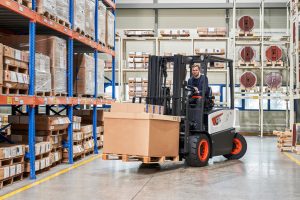
The long-established 60-40 market split between IC and Electric counterbalance forklift trucks, once in favour of diesel, is now seeing a dramatic shift, one which is set to continue apace in 2026. Established and fast-developing battery technology supports the move. Electric counterbalance trucks are now fully capable of working outside, eight hours a day, in dirty and dusty environments such as builder’s yards and industrial sites. And heavy lifting is no longer the sole domain of IC engine vehicles, as electric models with capacities up to 8,000kg and above are now in wide use.
Electric trucks are cleaner, quieter and cheaper to maintain, however, there are choices to be made over battery type and charging options. Lithium-ion batteries are increasingly seen in fast-moving, multi-shift operations but it’s essential to have adequate time set aside for top-up charging throughout a shift. In many instances lead-acid remains the best option.
Although IC engine forklifts may still be preferred for particular applications, hydrogen fuel options may soon be seen more widely in use, as buyers move away from carbon-based fuels such as diesel and LPG. A trend that may well gather pace in 2026.
3. Drive for flexibility and agility will boost mixed fleets
Increasingly, organisations are uncertain about the future demands on the business and what changes may be required within the fulfilment operation. Will there be more promotional activity, resulting in sharper peaks? Or could there be longer, extended peak periods, with a greater number of returns? Could product profiles shift, SKUs radically expand, and how might new, spontaneous marketing initiatives impact operational processes?
Reliability, flexibility and performance will be core attributes required of the materials handling fleet in this year. Rigid fleet ownership models will become less attractive, as businesses turn to flexible hire and leasing options, enabling them to scale up or down quickly without locking up capital. Suppliers of materials handling equipment capable of supporting responsiveness and agility through blending a ‘best for purpose’ mixed fleet, will play an important role for businesses in 2026.
4. Automation and ‘the connected fleet’ fit for a digital age
Warehouses and fulfilment centres will become more integrated, more intelligent and more connected. Digital transformation of the warehouse will continue apace in 2026, with increasing levels of automation, principally in the form of AMRs, AGVs, shuttles and sophisticated conveyor systems. However, businesses will need to ensure they have the expertise within the business to deliver a viable solution with a reasonable ROI.
As part of this mix, forklift fleets will become more integrated within the warehouse too. ‘The connected fleet’ is now a reality for a growing number of businesses, not just large fleet owners. Insights gained from analysing vehicle usage data will help drive overall performance and provide valuable guidance on optimising the size and shape of the fleet.
Telematics and intelligent fleet software, such as Rushlift’s on-line proprietary Fleet Management System, can gather data on vehicle usage and overall performance of the fleet, enabling management to make data-driven decisions in real-time, such as reallocating resources to where they’re needed quickly. In addition, remote access by off-site service engineers will increasingly help extend vehicle up-time, facilitating preventative maintenance, fast diagnostics and enhanced operational resilience.
5. Managing complexity, key to greater productivity
With cost pressures rising for businesses as 2026 gets underway, there will be even louder calls for higher levels of performance and operational resilience within the warehouse. This will require coordinated action, and quite likely, expert help.
Specialist material handling service and support businesses, such as Rushlift, work closely with fleet owners over the entire length of the contract to maximise the overall performance of the fleet: from specifying and recommending the most appropriate trucks for the duties to be performed – and that means providing the best truck for the job, whatever the make – to providing full, regular servicing, fast breakdown call-out, and on-site meetings to review fleet performance.
Craig Davenport is sales director at Rushlift
For more information:
Tel: 0800 731 5035
Related posts
IPE Newsletter
IPE publishes a weekly eNewsletter, delivering a carefully chosen selection of the latest stories straight to your inbox.
Subscribe here