

Moving forward with ‘big’ ideas
The setting up of BEKO Systems was
important to the BEKO group
because it gives the company
capability in very large dryers. The
Everdry range of heat regenerated
adsorption dryers extends to
20,000m3/h and the company
The setting up of BEKO Systems was
important to the BEKO group
because it gives the company
capability in very large dryers. The
Everdry range of heat regenerated
adsorption dryers extends to
20,000m3/h and the company can
provide tailor-made solutions
beyond this figure.
Drying compressed air to low dew
points such as -40°C is expensive.
The desiccant medium has to go
through a regeneration process to
drive off the water adsorbed but then
must be cooled before the desiccant
can start drying again. The industry
standard, says Beko, is that a
desiccant dryer is two columns filled
with desiccant. The first column
dries the compressed air until the
desiccant is partly saturated; the other
column then comes on line and the
wet column is regenerated and cooled.
All this takes energy and the trend
has been away from any kind of
purge loss of compressed air. Beko
believes the solution to reduce
drying costs is the HOC, heat of
compression dryer. This uses the fact
that compressing air raises the
temperature of the air in 2- stage,
non-lubricated compressors to
approaching 200°C. In other drying
solutions this heat is allowed to pass
downstream where it can be
recovered and used, but in many
cases goes to waste through the
cooling system.
Heat of Compression Dryer
layout: This type of dryer can offer
low dew points and low running
costs. Different types of compressors
require different versions of HOC
adsorption dryers. The standard
range meets these requirements. The
Everdry HOC-R (reload) provides
stable pressure dew points lower
than -40°C. Beko says demand for
high quality air for the electronic
industry with pressure dew points of
-70°C will be realised with the Reload
procedure. Beko has three other
ranges of classic twin column/tower
heat reactivated adsorption dryers.
FRP heat regenerated adsorption
dryers: Heated blower air regenerates
the desiccant and a small purge flow
of expanded dry air cools the
desiccant. This product, with few
components, is designed for
customers who need to keep capital
costs to a minimum. Performance
range is 580-40,000m3/h, dew point
is to -40°C at pressure. It is suitable
for all climate zones.
FRA heat regenerated adsorption
dryers: These use heated blower air
to regenerate the desiccant. Cooling
is by ambient air and a blower.
Performance range is 580-40,000
m3/h, dew point is to -40°C at
pressure. Units are suitable for
moderate climate zones
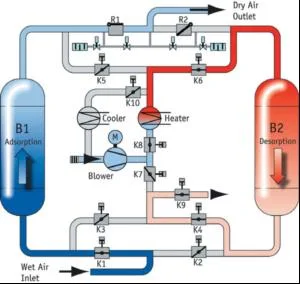
FRL heat regenerated adsorption
dryers (pictured): The FRL dryer is
aimed at critical ambient conditions,
normally high temperatures and has
a closed circuit loop for cooling
using blower air and the regeneration
by heated blower air. Performance
range is 580-40,000 m3/h, dew point
is to -70°C at pressure, and it is
suitable for all climate zones.
Beko Technologies Ltd
Email: [email protected]
Website: http://www.beko-technologies.co.uk
Phone: 01527 575778
Address:
Unit 11-12 Moons Park
Burnt Meadow Road
North Moons Moat
Redditch
B98 9PA
United Kingdom
IPE Newsletter
IPE publishes a weekly eNewsletter, delivering a carefully chosen selection of the latest stories straight to your inbox.
Subscribe here