

Quick to achieve a lasting bond
Modern instant adhesives can help to make production
processes faster, safer and more economical, as Colin
Chapman of Henkel, manufacturer of Loctite brand
products, explains
Adhesive bonding is one of the fastest
gr
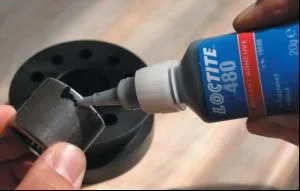
Modern instant adhesives can help to make production
processes faster, safer and more economical, as Colin
Chapman of Henkel, manufacturer of Loctite brand
products, explains
Adhesive bonding is one of the fastest
growing techniques employed to
join materials in modern
manufacturing processes. When properly
selected and applied, adhesives achieve
lasting bonds between virtually all materials
and in any combination.
So-called ‘instant adhesives’ are playing an
increasingly important role in industrial
manufacturing. They offer
advantages over traditional
material joining processes
such as ultrasonic and solvent
welding, or mechanical
fastening methods such as
clipping or bolting. Benefits
include the ability to cure
quickly, no discolouration
or distortion of substrates,
and a weight reduction of
finished articles. In
addition, they can be used
to bond similar or
dissimilar combinations of
plastic, rubber, metal,
textile, wood or paper
materials – without damaging
the materials either chemically or thermally.
Adhesives allow full-surface bonding, rather
than joining only at isolated, highly stressed
contact points.
Instant adhesives, also known as
cyanoacrylates (CAs), are suitable for
bonding small and medium-sized parts to
achieve a close fit in production situations.
Parts can normally be processed without any
additional surface preparation, although for
best results the substrate should be clean
and free of grease. Once applied, the
cyanoacrylate cures within seconds by
reacting with the moisture on the surfaces of
the parts. In fact, sufficient strength is
created to allow further processing after only
5 to 20s, making CAs suitable for fast
production turnarounds.
Cyanoacrylates can be found in a diversity
of applications, including bonding rubber
feet to ABS housings, attaching clips and
switches to mobile electronic devices, and
forming flexible gaskets on steel.
Multipurpose products
While multipurpose adhesives deliver good
results for bonding a variety of different
material combinations, specialty products
have specifically engineered characteristics
which extend the spectrum of possible
applications. For instance, within this
category are adhesives for difficult-to-bond
plastics such as PP, PE, acetal, PTFE or
silicones. In fact, choosing the right product
is essential to get the best results.
For example, the elastomer-modified
cyanoacrylates offer good impact and shock
resistance and are, therefore, used to bond
loudspeaker parts, the housings for
rechargeable batteries in power drills, or
similar applications.
Flexible products, on the other hand, can
reliably withstand repeated twisting or
bending of the bonded materials. As a result,
they are suitable for bonding plastic sheaths
on the metal temples of flexible-frame
sunglasses or for attaching rubber profiles to
refrigerator doors made of painted metal.
For transparent parts requiring very good
optical performance and clear bondlines,
light-curing cyanoacrylates are a good
choice.
Gap-filling bonds
Cyanoacrylates work by utilising the
condensed humidity on the substrates to
initiate the curing reaction. This reaction
originates from the substrate surfaces and
migrates towards the middle of the joint.
Since conventional cyanoacrylates cure from
the surface and mostly have low viscosity,
they are used only to join close-fitting parts.
However, the scope of applications in
production processes has been broadened by
the addition of a gap-filling cyanoacrylate.
Known as Loctite 3090, Henkel believes this
product enhances the use of instant
adhesives through its ability to fill gaps up to
5mm. This new adhesive can be used on
metals, most plastics, rubber and ceramics.
Even porous substrates such as wood, paper
and cork can be reliably bonded.
Formulated as a high-viscosity gel, this CA
allows easier application to difficult vertical
surfaces – without dripping. Unlike onecomponent
systems, Loctite 3090 does not
depend on the moisture on the surfaces for
curing, but uses an additional activator. The
two components are dispensed into an
integrated static mixer, which ensures that
curing is triggered within the defined timeframe,
regardless of moisture or temperature
and the component parts of the adhesive are
always correctly mixed.
So, cyanoacrylates, instant adhesives –
whatever you want to call them – were an
instant success when they were introduced
and I believe that they have now formed a
‘secure bond’ with both industrial users and
consumers.
IPE Newsletter
IPE publishes a weekly eNewsletter, delivering a carefully chosen selection of the latest stories straight to your inbox.
Subscribe here