


Robots:Key to future success
Manufacturing is one of the fastest growing sectors of the
UK economy. It is critical that it is – and remains – globally
competitive. Here,Barry Weller of Mitsubishi Electric looks at
the role robots are assuming in hel
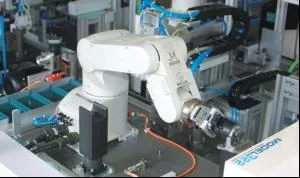
Manufacturing is one of the fastest growing sectors of the
UK economy. It is critical that it is – and remains – globally
competitive. Here,Barry Weller of Mitsubishi Electric looks at
the role robots are assuming in helping modern production
reduce costs and become adaptable for future changes
The UK manufacturing industry faces a
plethora of challenges in its efforts to
regenerate, but without doubt one of
the most significant is the need to operate in
a high-wage economy yet produce goods that
are competitive with those from low-wage
regions of the world. As UK manufacturers
cannot match the pay rates of some overseas
competitors, the only viable solution is to
reduce the labour content.
It’s not too difficult to see that this means
making the maximum possible use of
automation. Just how that automation will
be implemented must be carefully
considered in the light of a second important
requirement – the need for flexibility. It was
once satisfactory to build custom-engineered
automated production lines dedicated to a
particular type and style of product. At that
time there would be reasonable confidence
that the plant could be used without major
changes for five years or longer, time enough
to recoup the set-up investment. Today’s
product life cycles are typically much shorter,
so production lines in most areas of
manufacturing must be flexible enough to
adapt easily and inexpensively to the regular
introduction of new products or redesigns.
Flexibility is one of the major benefits
offered by industrial robots, as they are
essentially general-purpose tools that can be
readily adapted for new tasks simply by
reprogramming them. It might be expected
that robots would have been enthusiastically
embraced by UK businesses; the reality has
been different. UK manufacturers have been
slow in their uptake of robot technology,
lagging behind nations such as France, Italy,
Spain and Sweden, as well as the more
obvious examples of Germany and Japan.
There is, however, evidence that this
situation is changing. A recent survey by
BARA (the British Automation and Robotics
Association) reports that in the first two
quarters of 2010, UK robot sales grew by
55% compared with the figures for 2009.
Interestingly, BARA notes that most of this
growth has come not from the automotive
industry, where the use of robots is well
established, but from the food and beverage
and pharmaceutical and healthcare sectors.
BARA says robot sales are increasing in
almost every country. Possibly this is
incentive enough for those businesses that
are striving to grow and to enhance their
competitive position but are still hesitant
about investing in robots.
Let’s review the benefits modern robots,
such as those in Mitsubishi’s extensive
MELFA family, have to offer. They combine
speed with accuracy, making them suitable
for use in even the most demanding of highvolume
production applications. Unlike
human employees, robots can operate 24/7
and never take holidays! Production lines
incorporating robots can, therefore, be
operated for whatever hours are necessary to
satisfy customer demand.
Robots are not especially fussy about their
working conditions. This means that, in
many cases, big economies can be made on
the amount of heating and lighting that
would be required if humans were employed
to carry out similar tasks. This not only
results in lower energy bills, but also in
reduced carbon footprint.
Compact design is another characteristic
of modern robots; using them can save space
on the factory floor. Often they can also be
used in areas, such as those adjacent to fast
moving machinery, where a human operator
would not be allowed to work unless
guarding and other safety features were
provided. Today’s robots are also suitable for
incorporation in existing production lines.
Then there are the issues of reliability and
consistent performance.Modern robots
incorporate modern technologies such as
brushless AC servomotors, have long service
lives and require little maintenance. In
addition, when used in conjunction with
absolute position encoders, these servo
systems ensure precise and repeatable
operation. Scrap and reject rates are
minimised.
Some companies have ethical concerns
over the use of robots as they are seen as
displacing human operators. In truth,
however, robots almost always do repetitive
tedious tasks for which it can be difficult to
recruit human employees. Also, if humans
are used for these menial tasks and receive
even the most modest rate of pay, there’s a
high probability that the goods produced
will be less competitive than those produced
on robot lines. This could easily lead to the
business shrinking, with a loss of jobs, rather
than growth. There are, therefore, sound
reasons for arguing that robots can help
protect jobs rather than eliminating them.
If the UK manufacturing industry is to
make the most of its current opportunities
for growth, it must be prepared to wholeheartedly
embrace the unparalleled benefits
that robot-based automation offers.
Related posts


IPE Newsletter
IPE publishes a weekly eNewsletter, delivering a carefully chosen selection of the latest stories straight to your inbox.
Subscribe here