

Driving home the training message
Fork lift training has a crucial role to play in Britain’s
workplaces, as David Ellison, chief executive of the Fork Lift
Truck association (FLTA), explains
No one ever starts their day hoping to
be injured. No superv
Fork lift training has a crucial role to play in Britain’s
workplaces, as David Ellison, chief executive of the Fork Lift
Truck association (FLTA), explains
No one ever starts their day hoping to
be injured. No supervisor looks
forward to taking employees to
casualty. And it should go without saying
that no manager ever hopes to tell a family
that their loved one was hurt – or worse –
while at work.
Yet the reality is that every day in Britain
one worker is hospitalised or killed as a
result of a fork lift truck
accident. Newly released HSE
statistics show that 369
‘serious’ accidents – requiring
at least three days off work –
were recorded in 2009/2010.
In many of these cases, better
training provision would
have significantly reduced
the accident risk.
However, this is just the
tip of the iceberg. Industrywide
research from Skills
for Logistics (Dec. 2010)
indicates that more than
half of all employees
working with and alongside
fork lift trucks are not sufficiently trained to
do so.
High costs, staff shortages and a lack of
management awareness regarding the duty
to train are believed to be behind this serious
shortfall.Whatever the case may be, by
neglecting to ensure appropriate training
levels, employers are placing lives, limbs and
businesses at risk.
The law is clear about management’s duty
of care in this crucial area. Under the Health
and Safety at Work Act 1974, employers are
required to provide whatever information,
instruction, training and supervision is
necessary to ensure employees’ health and
safety in the workplace. The Management of
Health & Safety at Work Regulations 1999
expands on this. It identifies situations where
training is particularly important, such as
when a new employee starts, exposure to
new or increased risks, or where existing
skills may be in need of refreshing.
Best practice
Fork lift truck training plays a crucial role in
the Association’s mission to make Britain’s
workplaces a safer place. That is why the
FLTA will be using this year’s National Fork
Truck Safety Conference (21st September
2011) as a platform to reach out to fork lift
truck users on this very subject. The annual
event – now in its ninth year -promises to be
an information-packed day. It provides a
cost-effective way of keeping up to date with
the best practice in the industry. Ideally,
every company would have a senior
representative in attendance, taking note of
new developments affecting safety and
communicating this throughout their
organisations.
This year’s theme – It’s no accident:
training saves lives – covers a full programme
of presentations from expert speakers,
including representatives from the HSE and
each of the UK’s Accredited Bodies for the
delivery of fork lift truck training.
Delegates will discover what the fork lift
truck industry is doing – and what
individuals can do – to effectively highlight
the importance of fork lift training in the
workplace.
Safety file:Training
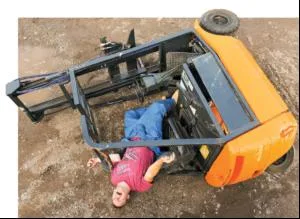
Recently, courts heard how an 18-year-old
employee was left hospitalised for a month
after being pinned to the ground by a fork
lift truck. The teenager, hired three weeks
earlier in his first job since leaving education,
was unloading the vehicle when it
overturned, landing on top of him.
The subsequent HSE investigation found
that during his brief employment he had
received no formal training on fork lift
operations and no induction training.
Furthermore, there was no evidence of yard
supervision or formal training among some
of the teen’s fellow truck users. The company
was found guilty of breaching the Health and
Safety at Work Act (1974) and fined.
After the hearing, HSE inspector Michelle
Morrison commented: “This was an entirely
preventable incident which caused serious
injuries to an employee in his first job.
Forklift trucks are involved in nearly a
quarter of all workplace transport accidents,
often because of poor supervision and
inadequate training. All companies that use
lift trucks must train operators to a
minimum standard set by HSE.”
IPE Newsletter
IPE publishes a weekly eNewsletter, delivering a carefully chosen selection of the latest stories straight to your inbox.
Subscribe here