

Bio-fuel trials: A burning issue
A bio-fuel field trial has been carried out by Nu-way, the
burner division of heating and combustion specialist
Enertech, to prove the viability of firing a B20 blend of class
D fuel and transesterified vegetable oil (FAME
A bio-fuel field trial has been carried out by Nu-way, the
burner division of heating and combustion specialist
Enertech, to prove the viability of firing a B20 blend of class
D fuel and transesterified vegetable oil (FAME)
With interest in alternative fuels
such as bio-diesel on the increase,
Nu-way has investigated the
modifications and adjustments required for a
standard burner specification to operate on
bio-fuel. Two projects were undertaken in
conjunction with Worcestershire County
Council’s Property Services team at a school
under its jurisdiction. Each ran for a period
of six months.
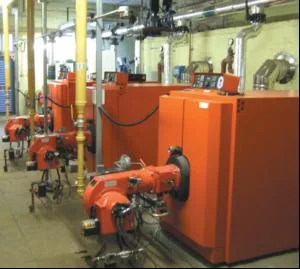
The trial site had three Strebel E500
boilers with Nu-way 440kW dual fuel
burners, of which two were converted to
biodiesel (and natural gas), each of which
have an output of 400kW. In addition, a
20,000L fuel tank was used to store B20 biodiesel
for the project, and components in the
fuel lines were upgraded to handle the more
aggressive nature of the bio-fuel.
Testing and set up for each burner was
carried out at the Nu-way development
laboratory and to ensure the correct output
would be achieved, the volumetric
throughput of each burner was measured
through a burette. Emissions were set to
provide the best possible combustion on the
test tanks.
As part of a condition-based maintenance
programme, the County Council’s Property
Services team managed the upgrading and
conversion of the kerosene-fired boilerhouse
to a dual-fuel installation, with a new fullycompliant
oil tank and feed pipe system for
the biofuel, and a new natural gas service.
A data logger was fitted to record such
data as lockout time, total number of starts,
hours run, number of change-overs to high
flame operation and total hours run at this
level. Once the trial started, monthly visits
were made to monitor the burners, including
a visual inspection of the burner head and
nozzle, fuel filter for build-up, and the heat
exchanger. Emissions checks determined the
CO2, CO and smoke levels.
An initial anomaly encountered with the
trial was the fuel turning dark red/black.
Deposits could be seen within the fuel which
turned out to be oxide from inside a fuel
pipe. The bio content in fuel is known to be
corrosive so fine grade filters were installed
within the line and the fuel returned to its
original colour within a month.
During winter, there was minimal drift in
combustion performance on the boilers one
and two with the CO2 holding stable at 10.5
to 11% with CO never being more than
1ppm. Smoke was rated 0 at the beginning of
the test period and 1 by the end, in line with
the use of standard gas oil and the
requirement to service class D burners every
six months. In addition, filters were still
reasonably clean after six months. Apart
from a small build up of material at the
bottom of the burner head, thought to be
due to after-spurting of fuel on shutdown,
the burners continued to function well with
good combustion.
For the start of the second trial, the slight
combustion drift from the first period was
corrected and the burner heads were left
untouched to see how they would cope with
build up over two heating seasons. Some
drift in combustion figures occurred on
boilers one and two with the CO2 levels
dropping from about 11.8 to 11% over the
first four months of the second trial. Nu-way
believes this to be caused by build up on the
combustion head interfering with the mixing
at the head. The CO remained the same as
the first period at 1ppm. Smoke readings
were 0-1 on low and 0 on high flame setting
for both boilers and this did not alter over
the course of the winter.
After two months use, the same fuel
deposits appeared in the combustion
chambers, but the flue ways remained clear.
Boiler one remained very clean while boiler
two showed a marginally higher build up of
sulphurous materials in the flue, but this was
not considered cause for concern.
The filters did indicate some deposit build
up but the element was not replaced after 12
months as would normally be expected
under normal service conditions. The fuel
remained normal, bright and clear. A further
build up of material was found at the
bottom of the burner head and blast tube,
however this would be easily removed during
regular maintenance.
Project conclusions
Any initial problems with fuel contamination
prove that when using bio-diesel with
existing equipment and installations, it is
important to have the tank and supply
pipework as well as all equipment, cleaned
thoroughly or replaced prior to
commissioning.
As a fuel, the B20 performed well and
both Nu-way and Worcestershire County
Council Property Services were satisfied that
it was possible to achieve stable and clean
combustion over an extended period of time.
In addition, emissions remained stable and
the same as class D fuel. All upgraded and
amended components performed well, with
no failures caused by the bio-fuel. The smoke
content was clean, with only small traces
appearing, but this was well below required
levels to meet regulations. Glazed deposits
appeared on the inside of the combustion
chambers, but Nu-way believes these can
easily be cleaned during regular servicing.
While more time may be required to carry
out this activity, it is not anticipated that
frequency of visits would need to be
increased.
The combustion heads showed some
deposits from the fuel spray, but again this
did not affect the burners’ performance
providing six monthly cleaning during
service is carried out.
The project has provided Nu-way with
performance data which is being used for the
development and supply of new bio-diesel
combustion equipment, plus the selection of
suitable components to create ‘biodiesel kits’
for the conversion of installed burners to
meet the needs of the ever-expanding
renewable energy market.
IPE Newsletter
IPE publishes a weekly eNewsletter, delivering a carefully chosen selection of the latest stories straight to your inbox.
Subscribe here