

Time to warm to cold forming?
Mark Jennings, technical director of Dawson Shanahan,
looks at the problem of rising material costs and how
different metals and production processes offer a
competitive alternative to traditional machining
Metal comp
Mark Jennings, technical director of Dawson Shanahan,
looks at the problem of rising material costs and how
different metals and production processes offer a
competitive alternative to traditional machining
Metal component manufacturers have
had to cope with a dramatic rise in
raw material costs in recent times.
The consensus is that prices will remain
high, with copper expected to maintain its
strength at just under $8000/t at the close of
the year. Considering that prices have already
rallied from just above $2800 per tonne in
December 2008 to a record high of $10,190 a
tonne in February of this year, the potential of
copper to command high prices cannot be
ignored. This has implications throughout
industry, as copper is used extensively in
many sectors from power generation and
distribution, to automotive and marine. The
problem is exacerbated by the fact that copper
inventories are falling to their lowest levels.
Many companies who rely on the red
metal are left to tackle the quandary of what
to do to remain productive, competitive and
profitable in such difficult times. For some,
the only solution seems to be increasing the
price of goods leaving the factory gates. In
practice, however, this is not always possible.
With most businesses today running lean
operations, there is limited potential for
further shaving of costs. Perhaps the most
viable options are to consider a switch to
lower cost materials, so long as they can
ensure that the required characteristics of the
finished products can be retained, or to
adopt cost effective production methods,
such as cold forming.
These latter options can deliver benefits to
industries using high volumes of copper to
produce precision parts and components,
especially those using a large quantity of mill
supplied Tellurium Copper (CuTE) rods or
bars. Although this metal machines well, the
processes that have traditionally been used to
create the finished parts and components, such
as milling, drilling and grinding, usually
generate a substantial volume of waste material
that adds to costs. For example, machining a
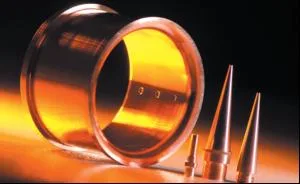
typical Tellurium copper nozzle for use in
plasma or laser welding applications,with a
finished weight of 36g, requires a block of metal
weighing 213g from which the shape can be
milled. This generates 177g of waste material,
over 80% of the total starting weight.At today’s
prices, this equates to over 85p of wasted
material per component.
By comparison, precision cold forming
produces minimal waste and typically uses
oxygen-free copper wire, which is often more
commercially viable than machining
Tellurium copper. Oxygen free copper is
readily available, so prices are competitive, and
generally lower than those of Tellurium
copper; as importantly, precision cold forming
oxygen free copper produces better results
than machining in many applications due to
its efficient electrical and thermal properties.
Particularly when it comes to the
production of high volume parts, such as
bevel, side and pinion gears and steering
racks, or smaller volumes of larger
components, cold forming represents the
most cost effective production method. This
technique can produce high quality
components, which have good mechanical
characteristics and a better surface finish with
less scrap – typically up to 80% less than
conventional part manufacturing processes.
Indeed, component costs can be reduced by
up to 70% in many instances, while lead times
can be cut by a similar amount. For instance, to
use the earlier example of a copper laser nozzle,
only a 54g billet would be needed to produce a
fully shaped part that simply requires a minimal
amount of final machining, resulting in waste
of just 18g or less than 10p in terms of cost.
Essentially, cold forming is the process of
producing metal components at low, usually
ambient temperatures without removing any
material. A simple blank, which has been
sawn or cropped from a round bar or wire,
or a cold headed pre-form is placed within a
die and a punch is applied to the blank. As a
result of the force, the blank then takes on
the form of the punch and the die.
There are a number of types of cold forming,
from forward and backward extrusion through
to freeflow. The type of component required
should be used to determine the method of
cold forming. Through extrusion, drawing or
coining, a blank can be made into a wide range
of components, segments and assemblies.
As cold forming is performed at ambient
temperatures, it is a quicker process than
more conventional options, allowing
manufacturers to achieve shorter production
times. High quality components can be
made to order quickly, cutting lead times and
the need to store high volumes of spare parts
onsite. Production cycle times can be cut
further on multi-station machinery, which
can be particularly useful in large production
runs. Accurate internal profiles and complex
external profiles are possible, enabling
precision parts to be manufactured that can
have a significant impact on the performance
of the assemblies and machinery in which
they are used.
There is almost no limit to the shape, size
or complexity of the metal components that
can be produced using cold forming.
IPE Newsletter
IPE publishes a weekly eNewsletter, delivering a carefully chosen selection of the latest stories straight to your inbox.
Subscribe here