

Thorough examination: Survey shows confusion
A survey by Consolidated Fork Truck
Services among companies owning
and operating fork lift trucks has
found that most Thorough
Examinations do not meet user
expectations.Many are confused by
what exactly is included an
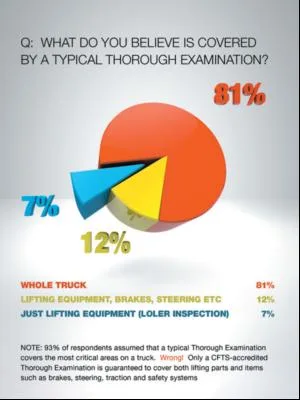
A survey by Consolidated Fork Truck
Services among companies owning
and operating fork lift trucks has
found that most Thorough
Examinations do not meet user
expectations.Many are confused by
what exactly is included and who is
responsible for making sure a truck
conforms to legal requirements.
Most respondents (93%) incorrectly
assumed that Thorough Examination
would automatically include an
inspection of their truck’s brakes.
According to Simon Emery, chair
of CFTS, the nub of the problem is
that the inspection of fork lift trucks
is governed by two separate pieces of
legislation: Provision and Use of Work
Equipment Regulations 1998
(PUWER 98) and Lifting Operations
and Lifting Equipment Regulations
1998 (LOLER 98).
Emery comments: “An alarming
number of inspectors only include
those items covered by LOLER – such
as mast, chains and forks – within
their inspection. They totally ignore
areas such as overhead guards,
steering, brakes and other vital
components.”
It was to overcome this situation
that the British Industrial Truck
Association (BITA) and the Fork Lift
Truck Association (FLTA), with the
support of the HSE, joined forces to
create a single, national procedure
available to truck users.
The result is a comprehensive
procedure and strict code of practice,
a programme of engineer and
management training and the
mechanism to monitor standards
under the CFTS brand.
Companies accredited to the
scheme (about 400) can be identified
via the ‘kite’ certification mark.
IPE Newsletter
IPE publishes a weekly eNewsletter, delivering a carefully chosen selection of the latest stories straight to your inbox.
Subscribe here