

Picking systems: Try before you buy
Many live storage systems are installed without achieving
the pick rates envisaged due to simple design issues that
could easily be picked out if a customer had access to a test
facility before installation, according to E
Many live storage systems are installed without achieving
the pick rates envisaged due to simple design issues that
could easily be picked out if a customer had access to a test
facility before installation, according to Ed Hutchison of
BITO Storage Systems.A test facility is essential, he says, in
achieving optimum performance
Nobody wants to find themself in a
situation where having installed
hundreds of lanes of pallet or carton
live storage in their warehouse, they find out
that their pallet of choice won’t run smoothly
down the lane.What happens if half the
pickers cannot comfortably reach the cartons
on the highest level of the carton live storage
system? These are not inconsequential
hiccups; extrapolated across an entire system
over a busy picking day, they can incur a
serious reduction in pick rates.
Yet these kinds of issues can be ironed out
easily at the design stage before installation
takes place. All it takes is the ability for a
customer to try out their live storage. This
will let them refine the design to meet their
precise needs and overcome any specific
operational challenges they may have.
A company buying an order picking
system needs to ensure it is ergonomically
friendly for its pickers, no matter what their
size, to allow operations to be carried out
easily and efficiently. Customers of BITO, for
instance, try out carton live solutions on an
ergonomic test bed at BITO’s Experience
Centre in Nuneaton, which is designed
according to the principals of the TÃœV
Rhineland Ergonomic Studies, the German
ergonomic certification and test mark.
A test bed will demonstrate clearly the
ergonomics of a new carton live system and
give customers the chance to refine the
design into a system that meets their needs
exactly. It’s usually small things that make
the difference. For example, will the pickers
need a step up rail within the system or not?
What incline angles will be within the carton
live lanes? Will this create good visual
contact for the pickers, who may come in
different shapes and sizes?
Ergonomics will influence pick rates and
gaining the optimum pick face means
designing it around the operative’s natural
picking curve. This will generally see fast
moving SKUs (stock keeping units) located
at the best possible ergonomic height for an
operative to pick quickly without bending
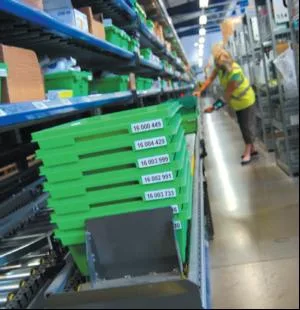
and stretching. Presenting cartons or pallets
at an angle will give the picker better access
and an improved view of what’s inside.
Providing a rail to help the less tall pickers
more easily access a higher pick location will
help. These improvements may only make
small time savings individually but add up
significantly across the course of a shift.
When it comes to trying out pallet live
systems, a test facility will determine perhaps
the most vital issue when it comes to gaining
full efficiency from such a system:Will the
pallet roll smoothly? When a company
invests up to a six-figure sum into materials
handling equipment they will want to be
sure that it meets their requirements and can
work with the pallet fleet in their supply
chain. This may have been a moot point in
the days of standard pallets when quality was
more consistent than it is today. Pallets today
can be made of virtually anything and their
characteristics are distinctly non-standard.
Mocking up a proposed live storage
system, either in a test facility or in a
customer’s own warehouse, will give the
customers the opportunity to touch and feel
a real system in the metal. They can have
their staff try it and make recommendations.
Take for example the experience of Dave
Chamberlain, logistics manager at Spirax
Sarco, British-based manufacturer of boiler
and pipeline control valves for steam heating
and process plants. He said: “We went to
BITO’s showroom to see how the carton live
system works.We then set up a sample
system in the old warehouse to run through
the ergonomics of the carton live, which
proved very successful.We paid particular
attention to ergonomics because with our
old silos the pickers couldn’t see the stock.
Now, however, they can see products clearly
and pick out of the carton quite easily.”
A customer can invite other suppliers of
materials handling equipment to try the
mock up to ensure that products, such as lift
trucks, AGVs or conveyors, will integrate
properly with the live system, particularly if
these devices are bespoke in any way. A
further benefit of a mock up is that customers
can gauge the quality of the system, important
as there are many cheap products entering
the UK market. Often these have no audit
trail making it impossible to determine the
quality of raw material used in their
manufacture.
The lesson then is to try out your live
storage system before it’s installed, make sure
it’s of the quality you would expect and that
the design is absolutely right for your needs.
Related posts

IPE Newsletter
IPE publishes a weekly eNewsletter, delivering a carefully chosen selection of the latest stories straight to your inbox.
Subscribe here