

Enclosures: Fit for hazardous areas?
When it comes to specifying enclosures for hazardous area
electrical applications, engineers must ensure they fully
understand IP protection ratings, as well as the implications
of modifying an Exd or Exe enclosure, says G
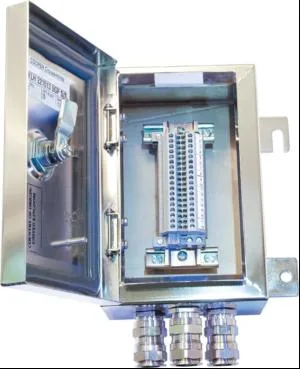
When it comes to specifying enclosures for hazardous area
electrical applications, engineers must ensure they fully
understand IP protection ratings, as well as the implications
of modifying an Exd or Exe enclosure, says Gary Johnson,
technical manager at COOPER Crouse-Hinds UK
As a manufacturer of enclosures for
harsh industrial and hazardous
environments, we often deal with
customers who don’t fully understand what
they require in terms of the IP protection
rating of an enclosure and
whether what they are asking for
meets the end users’ technical
specification.
The function of an enclosure
is to protect the internal
components from excess heat,
humidity, dirt, dust or water.
The customer could be
sourcing an enclosure for a
hazardous gas environment
such as an oil platform or
petrochemicals plant, or for a
dusty environment such as a
flour mill or sugar production
plant. In either case, it is
crucial that he or she fully
appreciates the differences
between the IP ratings along
with the requirements for one
that is fully certified for use in
a hazardous gas or dust
environment. In terms of
modifying an enclosure, either
prior to or after installation, it is equally
important that the installer and end user
fully appreciates what they are allowed to do
with that Exe or Exd enclosure so as not to
adversely affect its protection rating or
invalidate the certification.
With an Exd enclosure, the box cannot be
modified once it has been manufactured and
assembled; otherwise the protection rating
will be affected. For example, drilling new
cable entries must only be carried out by the
manufacturer or by an approved local
assembler (distributor). Once an Exe
enclosure leaves the factory, although this is
in a certified state, end users may then
modify that box prior to or after installation
within certain guidelines. Any alterations
need to be communicated to the
manufacturer or local assembler to ensure
that the correct certification is given or
maintained. These modifications normally
involve adding some extra cable entries or
terminals. Cooper Crouse-Hinds normally
supplies a range of standard
hazardous area Exe enclosures to
its network of
approved local assemblers, who are then able
to carry out modifications to those
enclosures to suit the application, without
adversely affecting the certification or
protection rating.
Enclosures for hazardous gas or dust
environments are normally manufactured
from stainless steel or GRP, but also painted
steel for some indoor, sheltered applications.
Some customers don’t fully appreciate that
an Exd or Exe enclosure has been put
through a series of arduous tests. These
include thermal conditioning (to represent
rapid ageing), which simulate 20-plus years
of operation in the field. In addition,
hazardous enclosures are subjected to a series
of mechanical impact tests, in places that are
considered to be the weakest points of the
enclosure (the test houses are experts in
finding these). If the material is considered
to have a reduction in resistance to impact at
lower temperatures, the box is also impact
tested at the lower end of the box’s operating
temperature range. These tests are important
because once installed in a harsh hazardous
area, it is often difficult to service an
enclosure due to the hazardous area or it
could get inadvertently knocked or bashed in
a working environment, so the enclosure
must remain intact in order to continue
performing the intended function for
protection.
In recent years, European and
International standards for hazardous area
enclosures have become even stricter in
terms of impact and thermal tests. In the
latest standards, all openings on the
enclosure are tested (opened and closed)
prior to their IP test.Many companies can
offer industrial-grade enclosures with an
IP66 rating, but for hazardous areas,
customers need to be absolutely certain that
the enclosures they source are fully certified
boxes that have been tested in terms of
temperature ratings and impact
protection.
It is generally accepted in the oil
& gas industry that hazardous area
enclosures need to be
manufactured from 316L stainless steel
as a minimum.Most of our hazardous
area enclosures are made from electrochemical
polished 316L high-grade
stainless steel as standard.
GRP enclosures also offer technical
advantages. The material is often
graphite-loaded in order to avoid
a build up of electrostatic charge,
which is important for
hazardous area applications.
Moulded, non-metallic enclosures also
enable the manufacturer to construct very
modular or flexible design features for the
customer, including quick-fitting of
components such as pushbuttons, switches,
lamps, and so on. Non-metallic enclosures
also enable you to design low-sided
enclosures for easier, faster wiring.With
stainless steel fabricated boxes, it is a little
more difficult to offer these features, but
fabricated steel enclosures are very flexible in
the size ranges offered; special sizes can be
quickly included, and they can also be
provided in much larger sizes if required.
IPE Newsletter
IPE publishes a weekly eNewsletter, delivering a carefully chosen selection of the latest stories straight to your inbox.
Subscribe here