

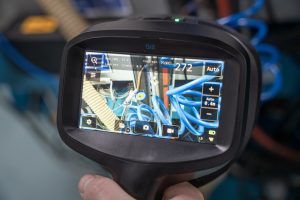
Cameras:Focus on developments
Thermal imaging has proved its worth across industry and
continuing high demand for cameras is testimony to that.
But where does the technology go from here? Andrew Baker,
sales manager of FLIR, comments of recent develo
Thermal imaging has proved its worth across industry and
continuing high demand for cameras is testimony to that.
But where does the technology go from here? Andrew Baker,
sales manager of FLIR, comments of recent developments
For most, a thermal imaging camera is
an essential piece of kit that is used
daily, not just housed in a cupboard
for an occasional inspection. This means it
must be fit-for-purpose and designed to
withstand the rigors of industrial
environments.
As a result new cameras are becoming
much more robust than their forerunners
and subjected to stringent drop tests to
confirm their durability.
Upgrades The choice of models in terms of camera
performance and dedicated applications
features has never been
greater. There is now
a model on the
market to suit every level of sophistication
and analysis and reporting needs. This is
important because as users work with the
technology they naturally discover new
applications for it.
So, for example, even though an engineer
may start with a fixed lens model, the
benefits of having interchangeable lenses for
various applications will become apparent.
And there is a wealth of choice enabling
users to upgrade their cameras in line with
their evolving experience and expertise.
Software The parallel development of analysis and
reporting software is also of significant
importance. Again the choice for asset
maintenance is fulsome and starts with
simple products that allow users to organise
and analyse radiometric images on the
camera and quickly present them in a report.
Intuitive and easy to use online tools are also
available for the same purpose.
Further up the scale are systems that
incorporate features such as fusion, trending
and provide greater flexibility in report
design and layout. And for the professional
thermographer dedicated software allows
advanced analysis of systems and structures.
An energy cost comparison report is one
example that allows the easy calculation of
achievable cost savings when the identified
structural problems are fixed.
Functions Complementing the breadth of choice is the
continuous development of various camera
grades. Even entry level models now have
some sophisticated features. The cost of a
basic troubleshooting model makes it
affordable across all engineering disciplines
and the performance of these cameras gets
better and better.
A good example is the inclusion of wireless
technology in thermal imaging camera
design. This provides significant application
scope as it allows data from a WiFi enabled
moisture meter or clamp meter to be
transferred to the corresponding thermal
image. So, for example, the relationship
between heat and power load can be seen,
bringing more intelligence to the inspection
process. This technology allows thermal
imaging cameras to ‘talk’ to mobile devices
such as an iPhone and iPad. The result is
greater application flexibility; it allows images
to be shared with colleagues, so swift
decisions can be taken on remedial actions to
prevent loss of production or minimise risk.
Applications Thermal imaging is proving suitable for the
maintenance of renewable energy plant. A
brake or a gearbox failure in a wind turbine
can be catastrophic. Uncontrolled speed of
rotation imposes excess loads on the blades
and can result in a fracture with life
threatening consequences. Increasingly thermal
imaging is being used for preventative
maintenance of these components. The
technology can pinpoint the exact component
whose thermal profile indicates an impending
fault. It is therefore a reliable, quick and
efficient method of spotting signs of wear on
a wide range of mechanical components as
well as electrical elements such as
transformers, connectors and controllers.
Caveat The entry cost to the technology continues
to fall and this is attracting more users.While
this is a positive development, it puts even
more emphasis on the need for training.
Thermal imaging cameras may be getting
smarter but that is no substitute for the user
fully comprehending the science behind the
technology. Knowing the principles of
infrared is a vital part of getting the best
return on the camera investment. At the very
least, attend a course that covers the basics;
better still, become a Level 1 thermographer.
Related posts
IPE Newsletter
IPE publishes a weekly eNewsletter, delivering a carefully chosen selection of the latest stories straight to your inbox.
Subscribe here