

Profile cutting: Options outlined
Oxy-fuel cutting, plasma cutting and laser cutting processes
are developing to offer better cut quality, higher cutting
speeds, lower operating costs and integration into
automated production methods. Ian Kirkpatrick, gene
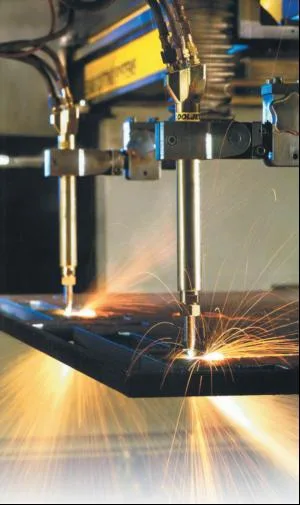
Oxy-fuel cutting, plasma cutting and laser cutting processes
are developing to offer better cut quality, higher cutting
speeds, lower operating costs and integration into
automated production methods. Ian Kirkpatrick, general
manager, ESAB Cutting Systems, explains
The most commonly used cutting
method for mild or low-alloyed steels
(3mm to 500mm) is oxy-fuel. Plate
is preheated to its ignition temperature with
a mixture of fuel gases (eg oxygen and
propane or oxygen and acetylene) and then
oxygen is used as the cutting gas. By
mounting one or more cutting torches on a
cutting gantry, which moves across the
workpiece, the process can be easily
mechanised.With the comparatively low
cost of cutting heads, multiple cutting
torches are used to provide simultaneous
cutting of identical parts economically.
Oxy/fuel gas cutting offers a number of
advantages as the capital cost of the
equipment is relatively low, power
requirements and maintenance costs are
low too. Oxygen, propane, natural gas and
acetylene are cheap and easy to come by.
Oxy-fuel gas cutting, however, is dependent
to some degree on the surface condition of
the material to be cut while its high heat
input can result in a wide heat affected zone
on the cut edge of the material.
The plasma cutting process is suitable for
conductive metals of all types and produces
a higher cutting speed in material of up to
about 40mm. Recent advances in precision
plasma have resulted in better quality and
hole definition to rival laser. Plasma is
suitable for bevelling materials that are
going to be joined by welding. Underwater
plasma cutting produces environmental
benefits.
The most commonly used plasma
systems are based on low-amp air plasma
(using air as the plasma gas). Plasma
cutting has been universally accepted as a
valuable tool in all sectors of the modern
metalworking industry, satisfying a range of
applications.
Generally, plasma systems have a low
capital cost, a low running cost and can be
used either manually or as part of an
automated profiling system. Indeed, the
ability of plasma systems to cut sheet metal
at speeds in excess of 6m/min has resulted
in the development of high-speed CNC
profiling machines to take advantage of the
process.
Although the use of air as the plasma gas
is acceptable for general-purpose cutting
applications, specific gases do offer
improved finishes. For example, when
cutting mild steel, oxygen is usually the
plasma gas that is used. Cutting this
material with oxygen rather than air also
offers a better finish, less dross, better
weldability and higher cutting speeds.
Another approach to higher quality
production cutting uses water injection
plasma systems as radial or vortex water
constricts the arc more effectively than a gas
injection type. The water also cools the
electrode and nozzle, which results in
longer life for consumables. It enables cuts
to be carried out under water to reduce
noise and glare from the plasma.
Precision plasma systems have extended
the application of plasma cutting into the
areas of precision light to medium gauge
applications. This technology is more
precise than conventional plasma while
offering similar flexibility. It works by
concentrating the cutting arc in a very small
diameter, using a much smaller nozzle
aperture than conventional plasma systems.
This results in a beam energy density that is
three to five times greater than that
achieved with conventional plasma, which
in turn results in a shallower temperature
gradient in the arc. As a consequence, both
edges of the cut are square, both the cut
width and heat-affected zone are narrower
and the heat-related distortion of thin
material is less.
The laser cutting process produces high
precision, extremely narrow sections and
high cutting speeds in thin material. It is
suitable for most materials – metals, plastic,
glass, wood, insulation material. However,
its main application is for cutting steel up
to 25mm thickness. Laser cutting also offers
high accuracy, as the tightly focused beam
produces a narrow cut with a high quality
edge, virtually no kerf and a very narrow
heat-affected zone.
The cutting capacity of laser profiling
systems is up to about 25mm steel plate,
though the high cost of laser sources tends
to limit its application to high value added
applications rather than general fabrication.
Laser beam delivery and guiding systems
enable fabricators to obtain the benefits of
accuracy and quality on larger and thicker
plate. Plate sizes to 20m long and 5m wide
can be processed.
It is accepted that on outside profiles
there is invariably little to choose between
high density plasma and laser, but the latter
certainly offers advantages where internal
profiles, intricate work and fine holes are
required.
IPE Newsletter
IPE publishes a weekly eNewsletter, delivering a carefully chosen selection of the latest stories straight to your inbox.
Subscribe here