

Cleaning the air to minimise risk
Oil mist, fume and smoke are major health and safety risks.
Kevin Bristow at air filtration specialist, Trion, explains how
air cleaning performance can minimise these risks
The processes and operations
undertaken
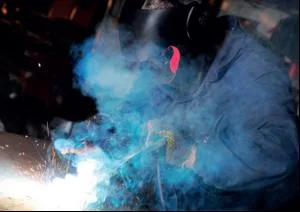
Oil mist, fume and smoke are major health and safety risks.
Kevin Bristow at air filtration specialist, Trion, explains how
air cleaning performance can minimise these risks
The processes and operations
undertaken in industrial and
manufacturing environments can
emit dangerous levels of oil mist, fume and
smoke particulates. These pollutants are a
major health and safety risk and can be a
severely damaging to the wellbeing of
employees,
equipment and
products.
Oil mist can be
particularly harmful.
The fluids used to
cool and lubricate
tools and stock in
metalworking
processes are
transformed into a fine
mist by mechanical force and
frictional heat. The mist can linger
causing health hazards, equipment reliability
issues and also contaminate products.
Employees exposed to oil mist can suffer
respiratory problems and, depending on the
level of exposure, allergic reactions and skin
disorders. If it’s not dealt with, then oil mist
will also eventually settle out of the
atmosphere, coating surfaces, equipment and
the building itself. Therefore, removing oil
mist from the air is essential for workplace
health and safety, and to maintain a clean,
efficient operating environment.
The Health & Safety Executive brought in
the Control of Substances Hazardous to
Health Regulations in
2002 (COSHH) which
requires employers to
control substances that
are harmful to employees’
health. These regulations
require regular monitoring
to ensure employers are
taking the necessary action
to control hazardous
substances.
Using effective air filtration
equipment will ensure a high level
of air cleaning performance and will remove a
greater variety of oil mist, fume and smoke
from the air. As a developer and manufacturer
of equipment designed to improve air quality
in industrial environments, we recommend
an electronic air cleaner which will provide
efficient removal of oil mist, fume and smoke.
Modern electronic air cleaners use
electrostatic precipitation (ESP) technology
which is suited to industrial applications. At
the heart of this approach is a high efficiency
collector cell. Contaminated air is first drawn
through the unit’s washable metal mesh prefilter,
which traps larger airborne particles.
Remaining particles, some as small as 0.01
microns, then pass into a strong electrical
field within the air cleaner’s ionising section,
where the particulate receives an electrical
charge. Charged particles then pass into the
collector plate cell, which is made up of a
series of equally spaced, parallel plates. Each
alternate plate is charged with the same
polarity as the particles, which repel, while
the interleaving plates are grounded to
attract and collect the particulate.
This type of electronic filtration can
remove contaminants more quickly from the
air than traditional carbon filters on their
own. A reduced dwell time requirement in
the unit translates to more efficient
performance – up to 95% sub-micron
particulate can be removed at an air velocity
of 3m/s. This performance, in turn, will have
an impact on the design, sizing and energy
efficiency of the entire system. Less power is
needed because smaller extract fans can be
used with smaller motors. In fact, the typical
power consumption of an electronic air
cleaner of this type equates to 50W, which is
equivalent to a domestic light bulb. At the
same time, there will be fewer issues with
sound attenuation.
Maintenance too can be an issue when it
comes to carbon filtration. However, an ESP
type air cleaner is designed to provide
optimum air cleaning efficiency while
requiring the minimum of maintenance.
Once the contaminated indoor air has passed
through the unit, clean air can be re-circulated
back into the workspace rather than
exhausted to outside, so saving energy costs.
At Trion we have a range of ESP air
cleaners to help remove damaging
particulates. Trion’s T1300, T2600 and T5200
are compact, low profile units which feature
electrostatic precipitation technology and
incorporate one (T1300), two (T2600) or
four (T5200) combined aluminium ioniser /
collector cells with stainless steel spiked
ionisers. Model choice, whether free hanging
or ducted, will depend on the size and
demand of individual applications, with unit
cleaning capacities ranging in air volumes.
In many industrial environments there is
no way around creating oil mist, fumes and
smoke but protecting employees from
hazardous substances must be of paramount
consideration. Using effective filtration will
ensure particulates are removed from the air
efficiently and quickly.
IPE Newsletter
IPE publishes a weekly eNewsletter, delivering a carefully chosen selection of the latest stories straight to your inbox.
Subscribe here