

Safety eyewear: Fit for purpose
Research carried out on behalf of Specsavers Corporate
Eyecare has revealed that 32% of health and safety
professionals believe staff remove safety eyewear due to
lack of comfort or fit. Jim Lythgow, the company’s director
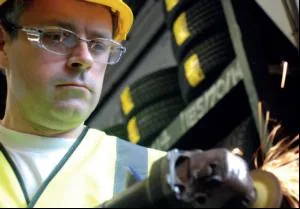
Research carried out on behalf of Specsavers Corporate
Eyecare has revealed that 32% of health and safety
professionals believe staff remove safety eyewear due to
lack of comfort or fit. Jim Lythgow, the company’s director of
strategic alliances, comments
Specifying ‘appropriate’ safety eyewear
relates to more than just the right
impact resistance for the task. Eyewear
must be suitable for purpose, carefully
selected and professionally fitted.
The importance of comfort is often
underestimated. Even the best, most robust
and expensive eyewear will not provide
protection if it is not worn. In fact, the HSE
places comfort and fit at the very top of its
‘key points’ regarding eye protection: ‘Make
sure the eye/face protection fits the user and
does not fall off easily. It should be issued on
a personal basis.’
For this reason, the procurement route for
safety eyewear is particularly important.
Even when buying a cheap pair of nonprescription
sunglasses from a high street
store, most people will at least try them on.
There are, however, plenty of PPE catalogues
and websites offering plain and prescription
safety eyewear with no opportunity for items
to be tried for comfort, let alone adjusted
and fitted for the individual. Researching a
supplier that offers a complete fitting service
can help ensure safety eyewear is worn by all
relevant employees, at all relevant times.
Spectacles, goggles, faceshields
There are three main types of safety eyewear:
spectacles (glasses), goggles and faceshields.
Plano (no prescription) off-the-shelf safety
spectacles have a single moulded frame and
lens. Goggles provide the next level of
protection, as they enclose the eyes from all
angles. Neither or these can be fitted with
prescription lenses. Faceshields are designed
to guard the face but do not offer full eye
protection. While it is possible to wear
eyeshields or goggles over prescription
glasses, these are not recommended for longterm
or regular use. There is obviously the
physical discomfort of wearing both together
and two sets of lenses can also cause light
refraction.
Lenses that are separately fitted to the
frames can be supplied to meet an individual
prescription as well as the required safety
standards. With side shields incorporated for
lateral protection, these spectacles may often
be appropriate for those in need of corrected
vision as well as eye protection.
Frame and lenses
The selection of the frames and lenses will
have a big impact both on the suitability for
the task and the comfort for the wearer.
Weight is a key consideration. Plastic frames
tend to be thicker and more rigid than metal
frames, making them less adjustable.
However, they may feel more sturdy and
secure. Metal frames are more flexible, so are
fully adjustable. They often include a saddle
nose pad which aids a more comfortable fit.
Choice of frame material may well come
down to industry-specific requirements.
The weight of lenses should also be taken
into account. For example, polycarbonate
lenses typically offer the greatest impact
resistance and the lowest weight.
With functionality and comfort satisfied,
aesthetics are becoming a more common
consideration, and it is now possible to
choose from male, female or unisex styles, in
various colours and finishes.
Prescriptive advice
Perhaps surprisingly, employers are not
legally required to provide an eyetest for
employees prior to selecting safety glasses. A
responsible employer will, however, surely
want to know that their employees can see
well enough to safely carry out their role.
Relying on an employee’s previous
prescription is not recommended as eyesight
can easily deteriorate.
When buying everyday spectacles, or
those for VDU use, it can be cost effective to
take advantage of offers and upgrades from
the optician. It is unlikely an optician will
offer upgrades like reactions lenses or
varifocals for safety eyewear: the optician is
not in a position to know every action and
environment in which the safety spectacles
will be used and specification changes should
never be based on assumptions.
Employees who require prescription safety
eyewear should be provided with the lens
type they most commonly wear. Safety eyewear
is not a good opportunity to experiment
with bifocals or varifocals if they are not
usually worn. It would be irresponsible too
for an employer to only provide single-vision
safety eyewear for an employee whose usual
spectacles are multi-focal.
Fit for purpose is of course of paramount
importance for safety eyewear. Fit for
comfort and fit for the individual are vital,
however, in facilitating the acceptance of
safety eyewear and helping to ensure that it is
worn all day, every day when required.
IPE Newsletter
IPE publishes a weekly eNewsletter, delivering a carefully chosen selection of the latest stories straight to your inbox.
Subscribe here