

Membrane dryers in the spotlight
The benefits of desiccant dryers and refrigeration dryers are
well publicised. There is a third solution, however, that Steve
Riley, general manager of Beko Technologies in the UK and
Ireland, believes is often ignored or
The benefits of desiccant dryers and refrigeration dryers are
well publicised. There is a third solution, however, that Steve
Riley, general manager of Beko Technologies in the UK and
Ireland, believes is often ignored or not fully understood –
the membrane type dryer
When a plant engineer has to buy a
compressed air dryer his first
consideration will be what
dewpoint is required and this will depend on
the application; specifications of machinery
using compressed air will guide the engineer
as will codes of practice such as BRC/BCAS
for the food industry. If a negative dewpoint
is required then a desiccant dryer will be
selected. The genre is likely to be well known
to the engineer and will attract a significant
capital and running cost particularly if a lower
capital cost, heatless dryer is selected.
An alternative scenario is for positive dewpoint
at typically 2° C and, again, an
engineer will know that a refrigeration type
dryer will handle this application with
relatively low capital and running cost but
that he must take care not to have pipework
going below the dewpoint temperature.
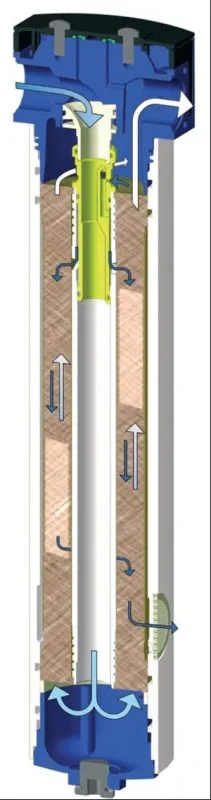
A third solution is the membrane type
dryer. Beko Technologies offers its Drypoint
M range of membrane dryers alongside its
Everdry and Drypoint RA, desiccant and
fridge dryers.
I was amazed at how many Drypoint M’s were
being sold when I joined the company. A
little research told me that 20,000 units had
been sold since launch, in the UK alone. I
guessed that many purchasers were original
equipment manufacturers because the main
benefit I had in my mind was the very small
footprint. I knew also that some compressor
manufacturers had a packaged unit which
included a membrane dryer but I couldn’t for
the life of me guess the diversity of applications.
Research also revealed overall cost as a
reason for selecting Drypoint M. This needs
some explanation as what tends to put most
engineers off is waste and it is a fact that
membrane dryers lose a quantity of compressed
air in purge loss. However this is not fixed and
Beko’s sales people have software which enables
the choice of a low capital cost, higher purge
loss unit or a higher capital cost and lower purge
loss unit. I wanted to understand what maintenance
revenue I would get from all these units. It was an
unbelievable number – zero, and it is not such a
short-lived product that if a problem should
occur it would be more economical to throw it
away. It is possible to destroy the membrane by
having too much liquid ingress but Beko’s design
team has produced a dryer with close coupled
separator and drain to protect against this
eventuality. In fact there are no wearing or
replaceable parts.
I have used the table below to show why I
believe that it is a mistake, certainly on smaller
flows, to disregard the option of a membrane
dryer.
Beko Technologies Ltd
Email: [email protected]
Website: http://www.beko-technologies.co.uk
Phone: 01527 575778
Address:
Unit 11-12 Moons Park
Burnt Meadow Road
North Moons Moat
Redditch
B98 9PA
United Kingdom
IPE Newsletter
IPE publishes a weekly eNewsletter, delivering a carefully chosen selection of the latest stories straight to your inbox.
Subscribe here