

Ways to form a special bond
Special fasteners are often required to meet special
situations. But, as Colin Chapman of Henkel – manufacturer
of Loctite products – explains, there are also ‘special’
adhesives available for use in exceptional situations
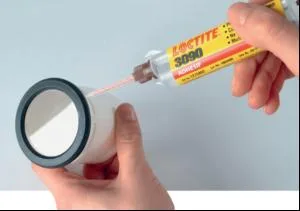
Special fasteners are often required to meet special
situations. But, as Colin Chapman of Henkel – manufacturer
of Loctite products – explains, there are also ‘special’
adhesives available for use in exceptional situations
Surfaces to be bonded should be clean,
but it is not always possible to achieve
the level of cleanliness required. In
some instances bonding will be needed on ‘as
received’ parts whose surfaces may be
contaminated with engine- or corrosionprevention
oils, cutting fluids or other ‘dirty’
materials.
Oil tolerant adhesives – in the form of
threadlockers and retainers – have been
around for some time, but some recent
developments have introduced significant
improvements in the performance of these
products and enabled them to be used in
‘special’ circumstances. In fact, today’s oil
tolerant threadlockers can effectively reduce
the need for special mechanical fasteners
such as spring washers, castle nuts and
plastic inserts. And the benefits of these new
threadlockers do not end there.
Coping with chrome
Recent industrial health and safety regulations
have prevented the inclusion of hexavalent
chromates in many coatings. As a result,
manufacturers are now switching to Trivalent
chrome. Existing anaerobic adhesives are not
compatible with the new coating and naturally
this has led to new developments.
As well as curing on active substrates such
as iron, copper, brass and steel, the latest
generation threadlockers are also effective on
passive materials including stainless steel,
zinc plated surfaces, inorganic and organic
coatings. This has given them far greater
application scope than before.
Special silicones
There have also been important developments
in the area of silicones. Traditionally, standard
single part silicones are slow to cure, have
limited cure through volume and their
optimum adhesion can be substrate
dependant. In most cases, a primer is needed.
To overcome these limitations, a new range of
two part products has been developed that
addresses all these issues. Like all silicone
products, they are extremely flexible and can
be used for bonding glass, metals, ceramics
and most plastics. In many cases, there is no
need for surface preparation.
The main benefit however, is the speed of
cure. These new two-part products allow
handling and subsequent use in very short
times; in some cases, handling strength is
reached within minutes.
Two part form
Cyanoacrylate (CA) is another adhesive
technology that has been recently developed
in two part form. These adhesives, previously
available only as single component products,
have always provided an ‘instant’ answer to
many bonding situations. Their versatility
and the capability to automate dispensing
operations have made them a popular choice
in a diversity of industries.
All those benefits – including an initial
bond within seconds – are still available with
the new two-component CA, but with the
added advantage that any exposed adhesive
remaining outside of the joint will harden
within 2 to 4min, removing the need for a
post-assembly activator.
Speedy epoxy
For those special applications (especially in
the area of maintenance) that demand an
epoxy to be used – but where a fast handling
strength is required, a new product is
available for general purpose repairs or the
speedy assembly of small components. It will
bond to a wide variety of materials, including
wood, metal, plastic and ceramic, and cures
rapidly to give handling strength in
approximately 5min.
Adhesive evolution
The original Loctite invention, developed in
1953, solved a problem that had been faced
by engineers for many years – how to stop a
screw vibrating loose. It became a ‘special’
product for threadlocking all manner of
fasteners. But developments continued
apace and the anaerobic principle soon
embraced other forms of bonding, such as
retaining, sealing and gasketing. With these
introductions, the need for many ‘special’
mechanical fasteners disappeared.
Since then, other adhesive technologies
have been introduced that have replaced or
augmented more traditional mechanical
fixing methods. Today, engineers turn to
adhesives for cost efficiency, automated
production, lightweight components, ease of
assembly and joint reliability.
Just as ‘special’ mechanical fasteners may
be called upon in specific circumstances, so
adhesives have been developed to meet
equally extraordinary circumstances. Rather
than being an afterthought, adhesives are
now first choice for many engineers
IPE Newsletter
IPE publishes a weekly eNewsletter, delivering a carefully chosen selection of the latest stories straight to your inbox.
Subscribe here