

Keep control of the fourth utility
It is often wrongly assumed that compressed air is a free
source of power; the reality, of course, is that the only air
that is free is the air that we breathe. Here, Malcolm
Crossley, sales manager – Air Treatment, Parker
It is often wrongly assumed that compressed air is a free
source of power; the reality, of course, is that the only air
that is free is the air that we breathe. Here, Malcolm
Crossley, sales manager – Air Treatment, Parker Sales UK –
offers some simple guidance on energy saving
Outlined below are some of the key
areas on which to focus to ensure
that a compressed air system is
operating as efficiently as possible.
Leaks
A major contributing factor to energy
wastage in compressed air systems is air
leakage. According to the Carbon Trust ‘an
average leak rate for a well maintained
system should be around 5 to 10% of air
generated to leakage. However it is noted
that in unmanaged systems it can be as much
as 40 to 50% of the generated output’.
Leaks can occur in multiple places. A
quick win for maintenance personnel is to
simply walk the line and listen. Look for
leaks in obvious areas such as:
Pipework
Fittings, flanges and manifolds
Hoses, couplings and tubing
Worn out system components.
Misaligned tubing
Maintain system components for leak free
operation. Look for worn out
seals on cylinders and valves. Use the spares
kits that most manufacturers supply and
change the seals on system components as
part of routine action. With new installations,
specify manufacturers who are placing the
emphasis on developing system components
with the latest seal technology to reduce leaks.
In line filters
In any compressed air system one of the key
factors in reducing energy demands is
effective filtration. In line filters essentially
protect system components from
contaminants in the airline. This ensures
optimum machine uptime due to less
frequent breakdowns. However with filtration
there are factors that need to be considered to
ensure energy efficiency:
Specify the right size filter: If the filter unit
is too small for the airflow required then
the pressure drop would be greater, thus
energy costs will be higher.
Specify the right level of filter: Examine
your application, what level of filtration do
your system components require? Install a
filter that matches those specification
requirements.
Proactively maintain filters: While
performing the job that they are intended
to do, filter elements will become clogged
with contaminants. This means pressure
loss. In too many situations operators
simply turn up the pressure via a regulator.
However this is a wasteful use of energy;
on average filters should be changed every
12 months.
Energy efficient dryers
Dryers are often installed in compressed air
systems to minimise problems of corrosion
and microbiological growth created by water
vapour in the air stream. This is especially
important if high quality air is required, for
example, in food or pharmaceutical
manufacturing. Dryers can use large
amounts of energy (especially if they are
poorly maintained). Indeed, drying costs can
sometimes be 80% of total operational costs.
There are a number of different types of
dryer available. One of the most efficient
types uses adsorption technology. An
adsorption, or desiccant dryer, consists of
two desiccant filled chambers, one drying
the air while the other is undergoing
regeneration, with a small volume of dried air
from the drying chamber being used as purge
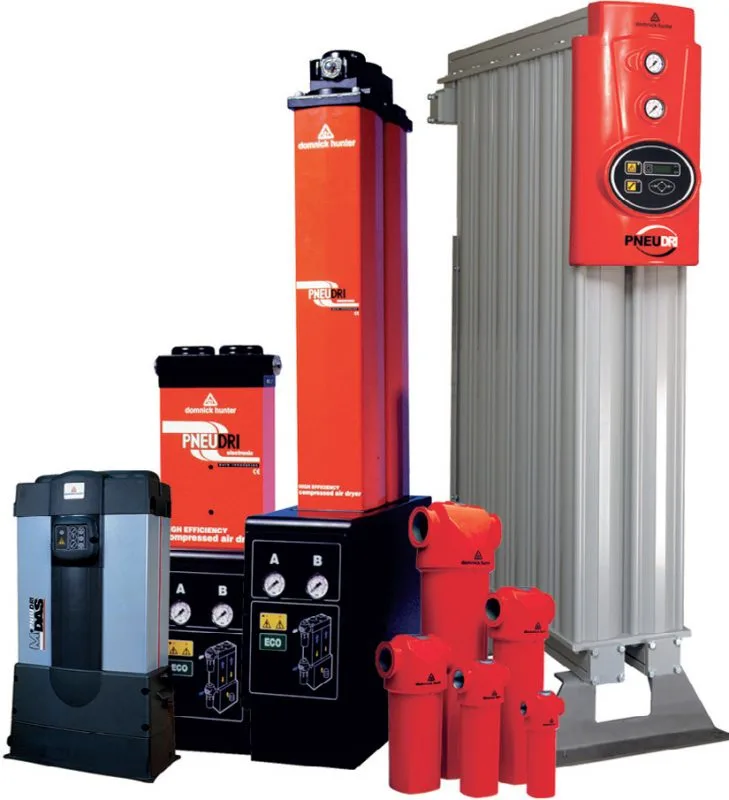
air. Recent systems, such as modular
PNEUDRI desiccant air dryers from Parker,
are now fitted with Dew point Dependent
Switching (DDS). This effectively eliminates
unnecessary desiccant regeneration cycles
and ensures that energy consumed is directly
proportional to the actual airflow, temperature
and moisture loading – not the rated capacity
of the dryer. This provides energy savings,
which can be in excess of 60%.
Compressed Air pipework:
In older airline installations galvanised steel
is heavily used. An inherent problem with
producing compressed air is that the
compressor introduces water into the airline,
thus causing rust and restricting air flow.
This causes the compressor to work harder
to supply the extra flow needed.
In new installations and for retrofitting,
aluminium pipe, that doesn’t rust, is
increasingly being considered. Aluminium
can sometimes be seen as a more expensive
alternative. However Parker has introduced a
Transair energy efficiency calculator to show
the over-time return on investment that its
Transair pipe systems can deliver with
respect to reduced energy costs.
By addressing the factors above, and with
the implementation of a proper on-going
planned and preventive maintenance
programme, cost savings are achievable.
IPE Newsletter
IPE publishes a weekly eNewsletter, delivering a carefully chosen selection of the latest stories straight to your inbox.
Subscribe here