

Evolving to meet today’s demands
Barcoding continues to play a key role in many diverse sectors despite the technology
being more than 30-years-old. Here, Brian Lang, European managing director of SATO
International Europe, looks at latest developments and
Barcoding continues to play a key role in many diverse sectors despite the technology
being more than 30-years-old. Here, Brian Lang, European managing director of SATO
International Europe, looks at latest developments and how the technology can help
those in industry and manufacturing improve their efficiency and streamline processes
The introduction of radio frequency
identification (RFID) technology gave
barcodes (a key technology in the
Auto Identification and Data Capture sector)
a new lease of life. Standard barcodes and
RFID enable those in industry to manage
their supply chain effectively; however,
although a barcoding system can work
adequately in isolation, companies usually
need to have established a working
barcoding system before RFID is
implemented as in many cases this
technology has been designed to enhance
and supplement – not replace – barcodes.
But, this aspect, coupled with the ongoing
higher cost of RFID labels and printers
required (compared with standard barcode
technology) and the considerably higher cost
of the initial RFID implementation, means
many have been reluctant to fully embrace
RFID. The economic downturn should also
be considered when analysing the resurgence
in investment in standard barcoding
technology.
Historically, a key driver for the use of
barcodes has been compliance, where
regulatory bodies stipulate that barcode
labels are used so that a large amount of data,
such as life-cycle, component and
manufacturer information, can be embedded
into a single barcode label. However, many
people are now choosing to implement
barcoding systems because it provides
opportunities to improve processes, supply
chain efficiency and cut costs.
Effective barcoding
Any effective barcoding solution would
include a number of basic elements that
would allow for the tracking of goods in and
out. Plus, the AIDC solution would need to
integrate with IT systems and provide
documentation of a product’s lifecycle from
the manufacturer to the customer.
An area of potential savings within many
diverse facilities centres around inventory
tracking. In a paper mill, for example, a large
paper making machine can have up to one
million different components but the
management of spares, in line with planned
maintenance regimes, can be streamlined
through the use of barcoding technology.
Instead of having excess stock levels, or
wasting time in searching for misplaced
stock, companies will know exactly what
they have got and where it is located. This
results in less upfront costs, better cash flow
management and less inventory taking up
plant space. The potential for savings is
substantial if this track and trace process is
done effectively on an automated scale.
Effective labelling and barcoding systems
bring multiple benefits which include the
reduction in inventory management
expenses, reduced stock levels, a reduction in
the need for manual checks, reduced product
recall costs, improved support
documentation for any track/trace protocol
established by regulatory agencies, support in
reporting of multi-component traceability,
saving time and money on labour costs.
Smart printing
The recent development of smart printing
technology has introduced a raft of benefits
to end-users, including improved
productivity, greater accuracy in goods
identification and substantial cost
reductions. Smart printing is able to
consolidate much of a company’s IT
infrastructure; centralising many of its key
printing processes within the printing device
itself. Now – with the right state-of-the-art
smart platform – the development,
installation, adaptation and maintenance of
software applications on a single printing
device can be a simple, fast process. Plus, by
running a number of different, often
specialised, printing applications on the same
printer; companies need rely on fewer
separate devices in the workplace, thus
freeing up space. Another benefit is that this
approach can easily adapt to suit changing
needs and market demands as the
manufacturer grows.
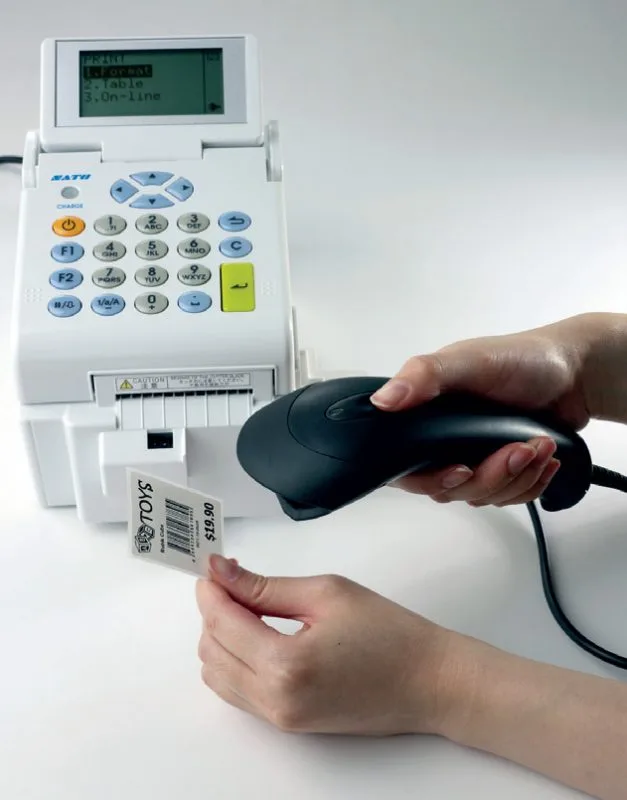
In the smart printing arena SATO has
introduced a cutting-edge printing platform
called Application Enabled Printing (AEP)
and the first product to feature this platform
is the new TH2 desktop and mobile smart
barcode printer. There is no need to invest
in a separate PC as the TH2 holds all the
required computing power within a single
unit. By moving the computing power to the
printer itself benefits related to time, cost,
space-saving, accuracy and flexibility can be
secured.
Innovation in the use of barcoding
systems has seen industry use this
technology for more than just basic purposes
such as inventory management and goodsin/
goods-out solutions. Now the solutions
range from quality control and ‘work-inprogress’
through to reverse logistics, and
barcode technology is supporting processes
that are essential to production. Despite
RFID’s initial higher expense it provides
many advantages, and when used with the
next generation of smart printing, industry
will be able to improve productivity and
increase efficiencies even further.
IPE Newsletter
IPE publishes a weekly eNewsletter, delivering a carefully chosen selection of the latest stories straight to your inbox.
Subscribe here