

Making light of lengthy loads
Materials handling provider, Combilift, and Danish
manufacturer Andresen Towers have pooled expertise to
address the logistical challenges involved in manufacturing
and moving extreme lengths of product which form the
bas
Materials handling provider, Combilift, and Danish
manufacturer Andresen Towers have pooled expertise to
address the logistical challenges involved in manufacturing
and moving extreme lengths of product which form the
basis of Andresen’s new tower construction
Andresen Towers is part of the IAI
Group which has more than 25 years
of experience in the production of
bended and bolted steel towers. The
company has taken its original concept a
stage further with the design of its patented
shell towers and has secured a long term
contract with Siemens Wind Power who will
sell its products. Production and warehouse
facilities have been set up at Andresen’s HQ
in Nyborg and nearby Langeskov.
Tom Andresen, CEO, says: “To make wind
energy a more competitive alternative to
fossil energy sources we have harnessed our
technology to build the next generation of
much higher towers. These can exploit the
better wind conditions to generate a larger
output which in turn reduces costs. For
example, an increase in hub-height from 80
to 125m will decrease the price/KWh by 25%.”
The increased height of the steel shell
towers compared to those currently available
is due to the larger diameter and the reduced
material thickness allows them to be
produced from steel coils. These are cheaper
than traditional steel plates and result in
lighter towers. No welding of the structure is
required as it is held together by tension
controlled bolts, which do not need any
retightening after installation.
Traditional tubular welded structures are
limited to a diameter of 4.3m governed by
road infrastructure (such as bridge heights)
when it comes to transportation. As
Andresen’s shell tower sections are designed
to be bolted together on site, they can be
easily carried on ordinary trucks or in 45ft
containers. Not only does this avoid extra
costs for special transport and reduce
disruption to traffic, it enables the shipment
of towers to previously inaccessible areas.
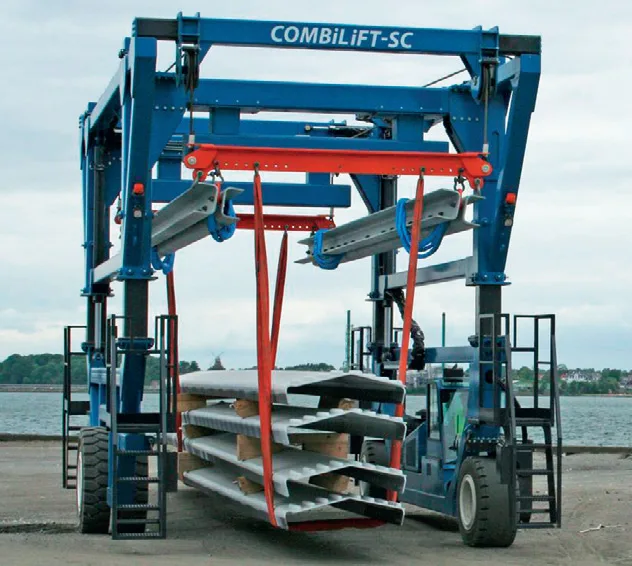
Having solved the problem of moving the
sections to their destination, a further issue
was how to safely and efficiently handle and
store loads which can be almost 14m long,
3.3m in diameter and weigh up to 30t. This
is where Combilift came in and a two way
dialogue with Andresen’s management led to
the choice of a Combilift Straddle Carrier
(SC) as the one machine solution for each of
the two sites. The design of each SC was
adapted to take into account the slightly
differing loads at Nyborg and Langeskov, the
latter being built with a larger frame to cope
with double-stacked high cube containers.
Ulrick Staudal of Combilift Denmark,
explains: “There were a number of options,
such as a combination of mobile cranes and
traditional counterbalance forklifts or reach
stackers, but Tom Andresen did not want to
invest in pieces of equipment that could only
carry out one specific job. He also focused
on the total cost of ownership, which is
becoming more of an issue for customers
than just the initial investment.”
With a weight of just 18t, the combined
weight of the SC and load is just 58t, which
has cut out the need for expensive foundation
work at Andresen’s sites. “Our calculations,
based on a 10-year operating lifetime took in
initial capital outlay, fuel consumption, service
costs and reduction in wear and tear on the
surfaces and proved Andresen could achieve
major operational savings compared to using
any other type of equipment,” says Staudal.
“The dimensions of Combilift’s SC and its
three-wheel manoeuvrability enable it to
access the production area to load crates
containing up to seven steel shells, weighing
from 1.3 to 3.25t each,” says Tom Andresen.
“The sheer physical size of a counterbalance
truck would have made this nigh on
impossible. We can then load onto HGV’s
without the need for a crane. In addition the
SC handles incoming containers of
components we manufacture elsewhere. The
spreader beam attachment with different lift
points also enables us to lift varying sizes of
loads. Inside and out, the SC has been ideal
for our needs and was a lot more economical
than any other options we looked at.”
Combilift’s Logistic Services assisted with
layout diagrams showing best use of space
for the storage of finished shells. Andresen
sums up: “By combining our expertise with
that of Combilift we have achieved all we set
out to, and within an impressively short time
frame.”
IPE Newsletter
IPE publishes a weekly eNewsletter, delivering a carefully chosen selection of the latest stories straight to your inbox.
Subscribe here