

Tugs, traction and reducing risk
Tugs can be used to help employees move heavy loads
easily, reducing the risk of manual handling injuries. Here,
Andy Owen, managing director of MasterMover explains
some of the issues to Simon Duddy, editor of IP&E’s sist
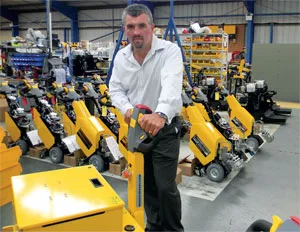
Tugs can be used to help employees move heavy loads
easily, reducing the risk of manual handling injuries. Here,
Andy Owen, managing director of MasterMover explains
some of the issues to Simon Duddy, editor of IP&E’s sister
publication – Handling & Storage Solutions
Outlining what he sees as key
benefits of the MasterMover
industrial tug range, Andy Owen
says: “The machines are pedestrian operated,
safe in comparison to forklifts and easy to
pick up and use. They don’t have the
restrictions of licensing associated with
forklifts. We’re seeing some customers say
they want to move away from using forklifts
inside premises. There is greater demand for
space and it cannot be wasted.
“Companies want to use premises for
valued production, not as space for forklifts
to operate. It can be expensive to add
extensions and buy new premises, so there is
an imperative to maximise space. Companies
can achieve this with smaller machines.
Traction
Traction too is an important factor for
MasterMover: “If you want to put extra
weight on a unit to develop traction, it’s a
restrictive and inefficient way of doing it.
What makes us stand out is our patented
design that allows customers to move heavy
loads with relatively light equipment.
“Our industrial tug range uses a weight
transfer principle, and utilises a hydraulic
lifting device, which sits over the top of the
drive wheel. When our interface connects
with the coupling system, it creates an
upwards force. We’re using some of the
weight of the load to generate a tractive effort.
“But it’s not just about moving the load,
smooth operation is key and we deliver this.
The operator only needs to concern himself
with steering; if he wants to stop he simply
lets go, and in a controlled manner, the tug
comes to a stop.All products are AC driven.
This allows us to programme the machines.
For example, in the pharmaceuticals industry
we could be moving a 1500kg load carrying
fluid. The customer doesn’t want abrupt
stops that move the fluid, they want very
controlled movement.
“In essence, a machine can have a host of
technologies – motors, control systems,
electronics, to create power and drive, but if
the wheel is spinning on the floor, the power
is worthless. Traction is key and that is what
we have mastered.
Reducing injury risk
“The use of the tugs reduces the risk of
manual handling injuries. We do a lot of
work in the healthcare and retail sectors,
which are very reliant on roll cages. One
person generally will move one roll cage
manually and these can carry 4-500kg. Our
Smart Mover, for example, takes the strain
off operatives. In addition, it increases
efficiency. It is a small device and is capable
of moving multiple cages. It’s easy to use,
hooks up to the first cage, and we’ve
developed systems to allow the tug to pull a
train. We find that safety and efficiency
improvements go hand-in-hand.
“In factories that manufacture high volume
products, our tugs are used to move products
and components from point to point in the
manufacturing process. Interestingly, in low
volume, high value manufacturing (such as
aerospace), the tug can become the semiautomated
track. The product becomes a low
cost ‘conveyor’, if you like.
Looking ahead
“We will launch two new products next year,
one for the industrial market and one for the
healthcare market. We’re also always looking
at new conversions and adapters for the
machines. The attachment side is very
important, and has to be designed well. We
test our attachments thoroughly as
customers may want to move 8t point to
point, and will want it to work in a
straightforward way.
“It is important in the healthcare market,
for example, to make sure machines interact
with the various equipment clients have,
while at the same time being as intuitive and
easy to use as possible. After all, lots of
people in healthcare are not accustomed to
using industrial equipment. There is a
learning curve.
IPE Newsletter
IPE publishes a weekly eNewsletter, delivering a carefully chosen selection of the latest stories straight to your inbox.
Subscribe here