

Measurement: Do your level best
Correct specification of level sensors can improve the
efficiency of industrial and process operations, as Charlie
Sorbo, level product manager for Gems Sensors and
Controls, explains
Level measurement is a fundamenta
Correct specification of level sensors can improve the
efficiency of industrial and process operations, as Charlie
Sorbo, level product manager for Gems Sensors and
Controls, explains
Level measurement is a fundamental
requirement of many industrial and
process applications and the demands
of plant managers have driven the designers
and engineers behind level sensors to
provide components that offer increased
reliability, lower maintenance costs and far
greater levels of precision.
When specifying a level measurement
solution, there are several factors to consider.
Cost is rarely the primary one, since the
original saving made by selecting the lowcost
option is often outweighed by the
expense of on-going maintenance. More
important factors are the nature of the
process material that is to be measured and
its material characteristics. Temperature and
pressure levels will need to be considered, as
will the substance of the tank that holds the
material. Specification also depends heavily
upon whether the process material is a
liquid, a slurry or a solid.
Compare, for example, the methods of RF
capacitance and conductivity in level
measurement. RF capacitance works on the
principle that the electrical capacitance
between two separated conductors changes
when the space between them is interrupted
by a quantity of non-conducting material.
For example, a conductive, sensing electrode
can be lowered into a metal tank to act as
one conductor, while the wall of the tank acts
as the other. As the level of process material
rises, covering a greater area of the
suspended electrode, a change in capacitance
is measured between the two conductors and
this is transmitted to an RF level transmitter
on the exterior of the tank, providing a direct
measurement of tank level. However, in
some applications, a steady build-up of
process material residue begins to coat the
level-sensing probe, causing errors of
measurement. Conductive level
measurement can avoid this problem. Here,
liquid level measurement is achieved via the
electrical conductance of the process
material, typically a liquid with a low-voltage
source, and offers a relatively low-cost,
simple method of detecting and controlling
level. In a tank of liquid, conductive sensors
are positioned at high and low points in the
tank to detect maximum and minimum
levels. When the level of process material
rises to reach the upper probe, a switch
closes to activate a discharge pump; when
the process material makes contact with the
lower probe, the switch opens to stop the
pump. Conductive level measurement is not
always the best option, but the example
illustrates the importance of carefully
considering the properties of the process
material before specifying the sensors.
Electro-optic sensors offer a further
method of measuring level. An electro-optic
sensor contains both an infrared LED and a
light receiver. Infrared light from the LED is
directed into a prism at the tip of the sensor
and, when no liquid is present, the light is
reflected within the prism to the receiver;
however, when liquid rises in the vessel to
immerse the prism, the light from the
infrared LED is refracted out into the liquid.
At this point, there is no longer any light
reaching the receiver, which actuates
electronic switching to operate an external
alarm or control circuit. There are now
electro-optic components on the market with
the potential to operate within extreme
temperatures ranging between -40 and
+125°C, offering ingress protection ratings of
IP66 and upwards, which can be used even
within extreme environmental conditions.
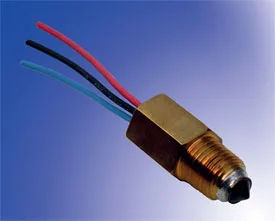
The robust construction of today’s electrooptic
sensors, such as the Gems Sensors &
Controls ELS 950M, coupled with the high
levels of performance and reliability they
offer, has enabled accurate level measurement
across a range of industries, providing powerful,
cost-effective solutions for plant managers in
many applications. Here, a modern, solidstate,
liquid level sensor with no moving
parts can perform the same task as a
capacitance sensor without the reduced
performance that can occur when a
capacitance sensor becomes coated by the
process material and begins to give false
readings.
All these innovations in level
measurement offer huge potential but to get
the best from any component you need to
ensure the right specification for your
operations. This may even involve supplying
a sample of the process material for
evaluation, along with a diagram of the
vessel, when working with your sensor
supplier. The effort will be worthwhile and
ensure maximum performance with minimal
maintenance requirements for your
industrial and process operations.
IPE Newsletter
IPE publishes a weekly eNewsletter, delivering a carefully chosen selection of the latest stories straight to your inbox.
Subscribe here