


Heating/cooling: All under control
A move away from steam heated platen presses to a thermal fluid heating and cooling system at TRB Lightweight Structures has produced a range of benefits, as Chris Horsley, MD of Babcock Wanson, explains
A move away from steam heated platen presses to a
thermal fluid heating and cooling system at TRB
Lightweight Structures has produced a range of benefits,
as Chris Horsley, MD of Babcock Wanson, explains
Established 60 years ago, TRB
Lightweight Structures is a leading
OEM for the rail, aerospace, defence
and marine industries, designing and
manufacturing tailor-made lightweight
solutions and bespoke fabricated assemblies,
including train doors and aircraft galleys.
Barry Kimber, the company’s facilities
manager, has been integral in ensuring the
manufacturing facilities and processes at the
site are maintained at peak efficiency
together with meeting the developing needs
of the business.
Kimber explains his decision to replace
the steam heating system: “When I joined
TRB, we were using two steam generators to
heat the presses, with water cooling and
condensate return systems. The water in a
steam system can become corrosive as acid
builds up in the condensate, which can lead
to damage in the pipework, and although we
had converted to stainless steel pipes, we
were always aware of the potential
environmental impact. The boilers were old
and were becoming expensive to run and,
conscious of the possible safety issues of
using an 8 bar steam process, we made the
decision to investigate other systems.”
For TRB, maintaining a constant
temperature control was crucial to providing
a consistent quality of product especially
with some of the high performance resin
systems being processed. The steam system
did not provide a constant temperature
without strict operating guidelines and was
labour intensive: “Without careful
management, we would have had insufficient
temperature control; the temperature could
drop off, which is something you don’t get
with thermal fluid heaters. We had to closely
monitor the temperature ramp up – as the
steam valves were opened, it could get very
hot very quickly which could impair our
process. The thermal fluid system provides
measured ramp up temperatures and also a
controlled cool down over a set time which
can be important with many of the latest
adhesives and resin systems.”
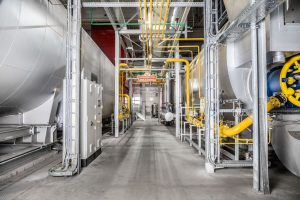
TRB fitted a Babcock Wanson TPC600B
fully automatic coil type, multi-pass thermal
fluid heater complete with integrated burner,
control system and safety devices. A single
fluid – Paratherm MR – is used throughout
the system which has a very flat viscosity
curve so is readily able to switch between
heating and cooling functions.
While the change from steam to thermal
fluid heating has made improvements in
production efficiencies and output, TRB has
gone one step further. Utilising Babcock
Wanson’s new menu driven software, TRB
now has the facility to create up to 50
programmes for the heating/cooling system.
Kimber explains: “This new software allows
us to enter up to six stages per profile, so we
can include the ramp up temperature and
time, platen temperature, cook, cool down
and dwell at the end of a cycle. It’s very
flexible. We have approximately 10
programmes as standard but with the extra
capacity and capability, R&D is exploring the
use of other raw materials, which will
continually drive the company to find new
market areas.”
This is made all the easier with the
software taking automatic readings every six
seconds. The data is readily retrievable by
simply downloading onto a flash drive.
Statistical information is then available in a
variety of formats, including clear graphs.
The software operates the Babcock
Wanson Temperature Control Units on each
press. They are connected to both the
heating and cooling distribution loops to
automatically feed the hot and cold fluid to
each press as and when required meaning
that each part of the line can be at a different
part of the thermal cycle at any given time.
Kimber adds: “Control of temperature is
very important to the product and therefore
to the business as a whole. With the new
system and software, we can be highly
accurate with the temperature control which
not only increases the range of products the
company can process but also considerably
increases panel capacity.
Related posts

IPE Newsletter
IPE publishes a weekly eNewsletter, delivering a carefully chosen selection of the latest stories straight to your inbox.
Subscribe here