

Automation cables:
Automated systems and robotics place tough demands on
the dynamic cables that provide them with power and
control services.Here, Giuseppe Di Lorenzo of Nexans takes
a look at some of the challenges faced by the company’s
Automated systems and robotics place tough demands on
the dynamic cables that provide them with power and
control services.Here, Giuseppe Di Lorenzo of Nexans takes
a look at some of the challenges faced by the company’s
Motionline range of automation cables
Automation cables have a very different
life from static cables, since they are
expected to deliver high performance
and total reliability across a broad spectrum
of chain, bus, sensor, robotic and control
applications – even under extreme dynamic
loads experienced at high operating speeds.
A key challenge that faces developers of
automation cables is the demand for an ever
smaller bending radius to provide the high
level of flexibility required by modern
installations.Where a bending radius of 7
times the cable diameter was once
considered normal, we are now
aiming for a bending radius as
small as 4 times.
The construction of the
cable has a significant impact
on the bending radius that
can be achieved. This
includes conductors, fillers,
insulation and jacketing. As
well as paying specific
attention to the
construction, a general
reduction in diameter of
the cable is required.
Although the design and
engineering of the cable are
important, the key to success is
in really close attention to consistent process
control to maintain the production of the
cable within tightly controlled parameters.
Need for speed
To achieve the desired high levels of
productivity and throughput, we are now
seeing automated equipment moving faster
and faster. For example, robotic spot-welding
machines routinely achieve repetition rates
of several hundred welds per minute. To cope
with this, automation cables not only need to
be lighter in weight, to keep their inertia as
low as possible, they must resist the high
stresses due to acceleration and ensure a long
fatigue life under repeated bending and
stretching cycles – as well as torsional cycling
in the case of 3-axis machinery.
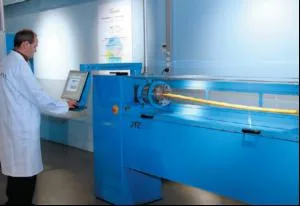
To ensure that its automated cables meet
this ‘need for speed’, Nexans is making
ongoing investments in its Automation
Application Centre, part of the Nexans
Research Centre in Nuremburg. This facility
enables cables to be exposed to dynamic
operating loads that simulate in-service,
conditions, thus ensuring that they offer the
combination of bending, tension and torsional
strength needed for their intended application.
As an example of how requirements are
becoming more demanding, we are now
carrying out acceleration testing at 50ms2, 10
times more than the previous level of 5ms2.
At the same time, we now expect cables to
achieve a cycle life of 20 million cycles –
double the 10 million cycles that used to be
accepted as an industry standard.
Environmental considerations
When you consider that automated systems
may be installed anywhere in the world, then
the behaviour of cables in extreme
environmental conditions becomes an
important consideration.We are now seeing
cables specified for both high temperatures
(90°C) as well as low temperatures (down to
-40°C). In fact, one of the most demanding
applications for automation cables is found
not in the factory, but in offshore wind farms.
It is important that cable conductor and
insulation materials provide the fire and heat
resistance demanded for safety and
performance, as well as offering resistance to
attack by oils and other chemicals. Important
developments in material technologies are
being made in this area such as TPM
(Thermoplastic Modified) insulation and
flame retardant PUR Medoxprotect-S jacket
material.
Hybrid cables
A key trend in the automation industry is
towards hybrid cables that combine power,
control and data cores within a single cable.
They are well suited to meet the needs of
decentralised control systems as well as
making installation easier and more elegant.
Engineered solutions
Nexans offers a wide scope of cable products
for automation under its Motionline brand
that conform to all major international safety
standards, such as German (VDE), Canadian
(CSA), American (ANSI), Chinese (CCC)
and UL worldwide. However, the catalogue
range is sometimes only a starting point,
since we frequently have to design and
engineer a special cable to deliver the vital
combination of high-performance, reliability
and long life required for a specific
application. This is especially true for
miniaturised installations where a cable often
needs to tailor made to fit the available space
envelope.
IPE Newsletter
IPE publishes a weekly eNewsletter, delivering a carefully chosen selection of the latest stories straight to your inbox.
Subscribe here