

More than one answer to energy question
In recent years, variable speed drive compressors have
become a popular choice. However, Andy Jones, general
manager at rotary vane compressor manufacturer Mattei,
explains why they should not be treated as an automatic
s
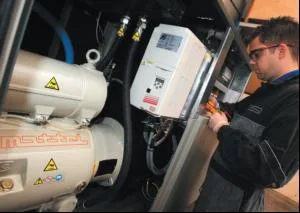
In recent years, variable speed drive compressors have
become a popular choice. However, Andy Jones, general
manager at rotary vane compressor manufacturer Mattei,
explains why they should not be treated as an automatic
solution for every application
Compressed air can typically account
for around 10% of a business’ total
electricity costs; this can rise to 30%
in some industries. Therefore, when looking
to purchase a new compressor either to
replace an existing machine or to meet new
demand, energy efficiency must be the top
consideration.With the Government heavily
focused on driving the green agenda and
looking at ways to lower the UK’s carbon
emissions and reduce energy
consumption, industry is
under increasing pressure to
account for its energy usage
and look at ways to make
savings.
Fourth utility
Compressed air is often
thought of as the fourth
utility, yet not every
business considers whether
its compressed air system is
truly efficient. It’s
important to remember
when buying a new
compressor, the initial capital
outlay actually makes up a very small part of
total lifetime cost. The main expense will
always be the energy required to produce the
compressed air, so it’s vital the compressor is
right for the application.
VSD machines
Compressor manufacturers have been
working hard to make compressors more
efficient and the introduction of variable
speed drive machines was definitely a major
advancement. VSD compressors work by
adjusting the air supply according to
demand, in contrast to conventional, fixed
speed compressors that give a constant air
supply. By precisely matching power
consumption to the required load profiles,
VSD compressors reduce energy losses,
typically producing savings of 30% or more
(based on Mattei’s Optima VSD compressor).
While variable speed drive compressors
have undoubtedly helped countless
businesses to reduce energy consumption,
there is a misconception that simply
installing such a machine is the only answer
to improving the efficiency of a compressed
air system. VSD compressors will only save
energy if there are peaks and troughs in the
air requirement – this sounds obvious but
it’s surprising how many are installed in
applications with constant demands.Many
manufacturing companies believe, or are told
by their compressor supplier, that their air
demand is variable and so invest in this type
of machine – assuming it will automatically
save them energy and money.
Understanding demand
The only way to confirm if a company
requires a variable or fixed speed compressor
is to obtain an accurate understanding of air
demands. Before a company invests in a new
compressor,Mattei always recommends an
initial data logging exercise, which evaluates
the business’ compressed air needs and the
efficiency of the system by recording and
measuring air consumption profiles over a
seven day period. This is usually followed by
discussions to identify any unusual patterns
or planned process changes.
Data logging only provides a snapshot of
compressed air activity, but, as long as it’s a
typical week, it identifies whether a company
has highs and lows in demand for air, or
whether requirements remain constant. With
a true picture of a business’ air demands, it is
then possible to make informed decisions as
to the type of compressed air system needed.
Understanding there is a need for both
variable and fixed speed compressors,Mattei
continues to invest in both technologies. For
companies that do require a VSD compressor,
it can offer a solution from its Optima range,
with off load power consumption below
10% and available in outputs from 11 to
200kW, with a capacity range from 1.19 to
35.5m3/min.
For systems with constant compressed air
demands operating for more than 4000h per
annum,Mattei has developed the Maxima
fixed speed range, available in outputs from
30 to 160kW with a capacity range from 6.45
to 31.8m3/min and uses as little as 5.4kW of
electricity to produce a cubic metre of air.
For companies with a constant base load and
a variable demand on top, a combination of
Maxima and Optima compressors can
provide savings.
With industry becoming burdened by
legislation to encourage it to lead the way with
environmental best practice, businesses need
to find ways to deliver genuine energy savings
rather than ‘green washing’ with changes that
sound impressive but don’t deliver.
Being able to adjust compressed air supply
according to air demands by utilising VSD
compressors can be a solution, but it’s
important to ensure they are only specified
when they are actually going to reduce a
business’ energy consumption and costs.
IPE Newsletter
IPE publishes a weekly eNewsletter, delivering a carefully chosen selection of the latest stories straight to your inbox.
Subscribe here