

A shift to thrift
The current recession could leave a legacy of improved resource efficiency as
businesses in the UK adopt an increasingly ‘thrifty’ mindset – according to a
new report published by sustainability expert Envirowise
The E
The current recession could leave a legacy of improved resource efficiency as
businesses in the UK adopt an increasingly ‘thrifty’ mindset – according to a
new report published by sustainability expert Envirowise
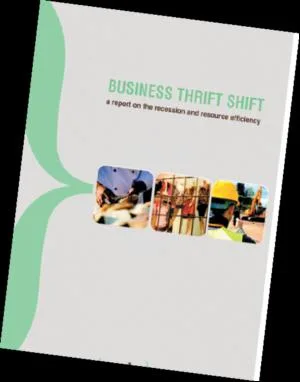
The Envirowise Business Thrift
Shift Report, which
encompasses responses from
more than 500 UK companies,
reveals that almost three-quarters
(73%) of businesses have developed
a more detailed knowledge of their
spending and resource use as a result
of the recession. This includes
everything from investment in raw
materials, transport and energy, to
staffing, equipment and professional
services.
For businesses, reduction of spend
on raw materials and consumables
was the biggest area of cut back
(38%), with a large number also
minimising their water, energy and
transport use. And this ‘thrift shift’ is
set to continue, with 89% of
respondents expecting to be more
careful about how they use their
resources once recovery comes.
Resource-conscious mindset
Simon Drury, Envirowise Strategic
Partnerships director, comments:
“Businesses – particularly SMEs –
have been facing some serious
challenges as a result of the recession
and this is perhaps reflected in the
number of survey respondents
reducing staff costs during this
period (41%). However, it is also
clear that for many companies this
period of economic difficulty has
stimulated a more resourceconscious
mindset, galvanising
environmental commitments that
had perhaps been lower down the
business agenda.
“We know from experience that
resource efficiency goes hand-inhand
with profitability, so it is
encouraging to see better
management of raw materials, energy
and water forming an important
component of the business response
to recession in the UK.
“Such an approach does not only
lead to financial savings; it can equip
businesses to face increasing levels of
environmental legislation and
provides an important competitive
advantage as customers become
more environmentally conscious.
These companies are not only more
likely to survive the recession in the
short-term, but are also better placed
to thrive when the economy begins
to recover.”
Commenting on the research,
David Caro, chair of the Federation of
Small Businesses’ Environment &
Energy Committee, says that small
businesses have had to adapt to
survive: “The downturn has brought
increased spending constraints for
our members which have been
exacerbated by the problems of
accessing credit during these difficult
months. Yet this tough economic
climate has also focussed attention
on increasing resource efficiency, not
only to maximise costs savings, but
also to meet the growing demand for
resource efficient goods and services.
“There is a growing consensus
among the SME community that
resource efficiency is not just a
symptom of the current downturn
but essential to remain competitive
in the transition to a low carbon
economy.”
Free guidance
The Envirowise Business Thrift Shift
Report is available at:
www.envirowise.gov.uk/thriftshift2009.
Businesses can access free guidance
and practical advice on resource
efficiency by visiting the organisation’s
website or calling the Envirowise
advice line (number below).
IPE Newsletter
IPE publishes a weekly eNewsletter, delivering a carefully chosen selection of the latest stories straight to your inbox.
Subscribe here