

Emissions control: Ceramic solutions
As more attention is paid to particulate emissions from
biomass boilers, forthcoming air quality legislation is set to
force a re-think on how we handle these emissions.Kevin
Stones, engineering and service director with H
As more attention is paid to particulate emissions from
biomass boilers, forthcoming air quality legislation is set to
force a re-think on how we handle these emissions.Kevin
Stones, engineering and service director with Hoval,
considers the implications
While there has been considerable
discussion about the impact of
vehicles and other heavy polluters
on air quality for some years, the recent
growth in the use of biomass boilers means
that particulate emissions from
biomass are beginning to
come under closer scrutiny.
This is because EC
Directive 2008/50/EC,
Ambient Air Quality and
Cleaner Air for Europe,
creates a requirement for
tighter control of the smaller
particles that are not filtered
by traditional mechanisms
such as multi-cyclones.
Consequently, we will soon
be faced with a need for
more efficient, retrofittable
filtration of particulate
emissions from biomass
boilers. Directive
2008/50/EC came into force
on 11 June 2008 and must
be transposed into national
legislation no later than June
2010. At this point, the Air
Quality Standards
Regulations 2007
will be revoked.
2010 will also be the
reference year for targeted
reductions by 2020 and while
modelling predicts we’ll be
4% short of target, the full
data will not be collated until
early 2012.
Size matters
Of particular significance in
these regulations is the size
of particles that will be
controlled. In the past,
emphasis has been on
particles with a diameter of
10 microns or above (PM10).
However, the new Directive will seek to
introduce a new control framework for
particles down to 2.5 microns in diameter
(PM2.5).
As noted above, the majority of these
particles in the UK come from vehicle
emissions but all biomass
boilers also make a
small
contribution to
particulate
emissions. The
level of
emissions will
vary with the
quality of the
fuel and
combustion
efficiency of
the boiler, so
using boilers
that comply
with EN 303-5
Class 3, in
conjunction
with high
quality fuel, is
the first step in
minimising
particulate emissions.
Of course, many biomass
installations already use a cyclone or
multi-cyclone to remove particles from flue
gases. However, cyclones are totally
dependent on the mass of the particles for
removal, so while they will remove around
50% of the coarser particles they do not
remove particles below PM10. This is why
the new Directive and its emphasis on PM2.5
has such significance for biomass
installations.
One alternative to cyclones and multicyclones
is electrostatic precipitation,
whereby particles are charged and removed
from the flue gases in an electrostatic field to
a collector. This is very effective for smaller
particles but electrostatic filters tend to be
expensive and often too large for typical UK
plant rooms.
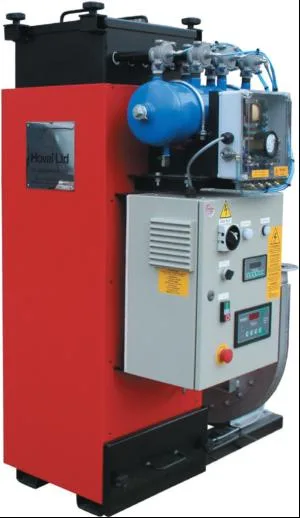
However, there is now a ceramic filter that
has been optimised for biomass use without
making the overall cost of a biomass
installation prohibitive. Capable of removing
up to 96% of PM2.5 and PM10 particles,
ceramic filters can be used with any type of
biomass boiler and can be retrofitted to
existing installations, so they have the
potential to address many concerns (real or
perceived) about particulate emissions.
Ceramic filters are connected to the back
of the boiler, in the same way as a cyclone.
Each unit contains a matrix of porous
ceramic tubes which are closed at the lower
end. The number of tubes in each matrix is
aligned with flue gas volumes for each boiler.
As flue gases are drawn through the filter by
an inline fan, the gases are able to pass
through the walls of the ceramic tubes, while
particles are trapped. At regular intervals
(timed and/or in response to a pressure drop
across the filter) a pulse of air is used to
dislodge the particles, which fall into a
collection bin.
Moving forward
Given that some local authorities have
expressed concern about biomass in urban
areas, there is a concern that failing to find a
suitable solution could severely curtail the
potential for biomass in the UK. This, in
turn, would have a significant impact on our
ability to meeting the country’s
commitments to reducing carbon emissions.
Ceramic filters have the potential to meet the
challenge of particulate emissions and ensure
that biomass remains as a viable element in
the UK’s renewable heating strategy without
compromising on air quality.
IPE Newsletter
IPE publishes a weekly eNewsletter, delivering a carefully chosen selection of the latest stories straight to your inbox.
Subscribe here