

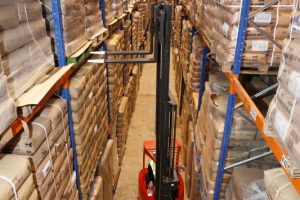
Articulating warehouse cost reductions in three steps
With warehouse space at a premium and labour costs rising, Narrow Aisle makes the case for articulated forklift trucks as a route to lower costs and greater operational efficiency
WAREHOUSE DENSITY, aisle optimisation and fleet rationalisation represent strategic levers to address the challenges of rising real estate costs, labour shortages and pressure to increase throughput without expanding footprint. In practice, this means optimising footprints with high-density racking, narrower aisles and vertical storage solutions. And here articulated forklift trucks play a central role.
Celebrating its 50th anniversary, Narrow Aisle pioneered the market for these trucks with the Flexi and offers three key points on how articulated forklifts can make an essential contribution to reducing warehouse costs and increasing order picking efficiency.
1. Space efficiency
Narrow aisle racking allows more stock on a smaller footprint, so SKU lines can be stored closer together to reduce order picking times and provide faster delivery. SKU variety is not only about size and weight but also throughput, i.e. a combination of fast, medium and slow-moving items. Quite often in larger warehouses this requires an order to be fulfilled by picking items located in several different areas; typically small items, fast movers and slow movers. Often, this will include narrow aisle pallet racking either for replenishment stock for fast movers and small items or simply house general goods.
The articulated forklift truck concept has enjoyed considerable success due to a design that allows it to operate in a narrower space than needed by a conventional reach or counterbalance truck to turn into a pallet position. This means that aisle widths can be reduced and more racking bays introduced.
2. Versatility
Able to handle a range of load types inside a warehouse, articulated forklift trucks are equally comfortable operating outside. This means that the truck can collect incoming pallet loads from the goods-in area and take them directly to the location in the racking. It can also take pallets from their racking locations and transport them to a waiting delivery vehicle in the yard. This eliminates the need to operate a two-truck system, and switching to a predominantly articulated forklift fleet can produce financial savings of up to 50%.
Because VNA trucks are difficult and costly to hire short-term, warehouses typically need enough of their own fleet to cover peak volumes. Articulated trucks avoid this problem. A Flexi can be hired as easily and cost-effectively as a conventional forklift, allowing operations to accommodate seasonal demand without permanent fleet expansion.
3. Picking productivity
Cost pressures mean order picking staff are often working harder and faster, increasing the risk of mis-picks, errors that can be costly to rectify, both financially and reputationally.
Retailers are increasingly holding less stock in-store, shifting more single-item picking and replenishment work into the warehouse. At the same time, growing product ranges mean more SKUs to pick from, putting further pressure on warehouse space. Articulated trucks support this model by accessing ground-level pallet positions for picking while reserve stock is stored above, with narrow aisle access also reducing the travel distance between racks, helping to ease the time pressure that contributes to picking errors in the first place.
Safety considerations
While the benefits of condensing storage aisles to their minimum width are obvious, warehouse operators must strike a balance between productivity and safety, particularly where order picking personnel are working in the aisles at the same time as trucks.
The use of warehouse trucks such as Man-Up Combis and VNA Turret trucks can compromise order picking efficiency and health and safety within warehouses where low-level order picking takes place. For example, a Man-up Combi VNA truck might lift the operator 10 metres in the air, but if you have someone in the same aisle order picking at ground level there is always the risk of the Combi operator not seeing the person below. Using articulated trucks mitigates these safety concerns. Because of its design, the Flexi is perfectly suited to working in narrower aisles alongside order picking staff.
Updating intralogistics solutions can deliver significant operational cost savings, and articulated lift trucks have an important role to play. Narrow Aisle's own Flexi range, for example, has sold more than 15,000 units across 75 countries over its five-decade history, evidence of the enduring demand for articulated trucks.
For more information:
Tel: +44(0) 121 557 6242
Related posts

IPE Newsletter
IPE publishes a weekly eNewsletter, delivering a carefully chosen selection of the latest stories straight to your inbox.
Subscribe here