

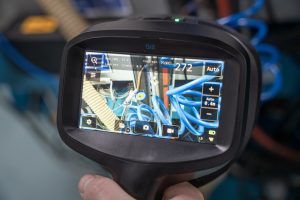
Infrared training: A growing need
Thermal imaging is an industry standard method for condition monitoring and preventive maintenance. The technology is now accessible to a much wider engineering community and, as a result, the need for dedicated training has become increasingly important. FLIR Systems explains
Thermal imaging is an industry standard method for
condition monitoring and preventive maintenance. The
technology is now accessible to a much wider engineering
community and, as a result, the need for dedicated training
has become increasingly important. FLIR Systems explains
The efficiency and application
flexibility of thermal imaging has
driven its take-up across all industrial
sectors and as a result camera costs have
fallen due to manufacturing economies. A
by-product of this is the requirement for
appropriate training. It not only ensures that
the user gets the best return on the camera
investment but that application standards are
upheld.
One of the staunch proponents of such
training is FLIR Systems. The company
created its Infrared Training Centre (ITC),
an independent organisation that provides
courses that range from foundation through
to professional level.
These courses have been continuously
developed over time by ITC experts. They
are based on the collective experience of ITC
worldwide to determine what
thermographers need to know. These
learning objectives are part of the ISO
compliant quality control system of FLIR
Systems in both Sweden and the United
States.
All students who complete a Level I, Level
II or Level III training course are eligible for
ITC certification which is valid for five years.
To be re-certified for an additional five years,
the student must demonstrate continuing
education in, or professional contribution to,
the field of thermography.
Level I qualification
So what do these various qualifications
mean? A Level I thermographer is certified
to perform industrial thermographic
measurements and fundamental infrared
thermography, including basic image postprocessing
according to established and
recognised procedures. This includes the use
of measurement tools, emissivity
adjustments and span & scale adjustments.
Put simply, a Level I thermographer can
use the equipment without knowing too
much about its inner workings and perform
uncomplicated measurements following
existing routines. He or she will be able to
detect obvious faults, recognise possible
errors in measurement and carry out post
processing and data collection.
In the Level I training course, the
emphasis is very much on hands-on training.
Theory is kept as simple as possible and use
of formulas, minimised. While the student
will leave the course as a competent user of
an infrared camera, they would need to defer
to a higher-qualified person to define
inspection routines and guidelines.
Greater depth
In the Level II course, this knowledge base is
expanded. The training course includes more
theory and goes deeper into the physical laws
that the infrared camera uses to generate an
image and measure temperature. It also
explores the causes, anomalies and patterns
that are commonly encountered in thermal
imaging.
The student uses more formulas and is
expected to be able to perform simple
calculations. Steady state and transient
mechanisms are examined in more detail
and the course work involves more
laboratory experiments. As a result the
certified Level II thermographer is qualified
to perform and direct infrared thermography
according to established and recognised
procedures.
For any professional thermographer, Level
III certification is the gold standard. It
signifies wide experience and a standard of
knowledge that meets internationally
recognised criteria. The goal of this course is
to enable pre-qualified Level II
thermographers to set up and run a successful
condition monitoring programme. And as
such, the instruction includes guidance on
acquiring and developing the necessary
personnel, resources and technologies.
BINDT accreditation
FLIR Level I and Level II thermography
courses have been validated by the British
Institute of Non-Destructive Testing
(BINDT) against its minimum requirements
for structured training of condition
monitoring practitioners. BINDT’s aim is to
promote and advance the science and
practice of non-destructive testing, condition
monitoring, diagnostic engineering and all
other materials and quality testing
disciplines. FLIR has worked closely with the
organisation for many years with the aim of
creating a quality standard in
infrared training.
“We are delighted that our
courses have been ratified by
such an important industry
body,” concluded Jon Willis
FLIR Systems’ ITC manager.
“This achievement also
gives industry the assurance
that the training we
provide is in compliance
with ISO18436
requirements for the
training and qualification
of personnel.”
Related posts

IPE Newsletter
IPE publishes a weekly eNewsletter, delivering a carefully chosen selection of the latest stories straight to your inbox.
Subscribe here