

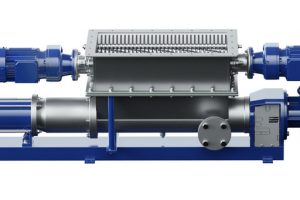
PC pumps: Delivering accuracy to the process
Dosing pumps are an important piece of equipment for manufacturers and processors across a range of industries. However, Lesley Eaton, business development and marketing manager, Seepex, says that while most positive displacement pumps are capable of dosing, progressive cavity (PC) pumps are becoming the dosing pump of choice for many
Many traditional dosing pump designs such as piston pumps, air diaphragm pumps and peristaltic pumps have a pulsating action. This pulsed flow means that once the pump has dispensed a product, there is a pause before it can dispense again. This results in a gap in the process and can cause uneven distribution of ingredients. Furthermore, some of these pump designs require check valves; if solid or viscous particles get caught behind the valves it can cause them to stick, blocking the pump and halting the process.
In contrast, PC pumps are virtually pulsation-free. They use a rotor/stator pumping action which delivers a continuous flow into the product stream. Seepex’s PC dosing pumps, for example, produce a stable flow rate with a linear accuracy of +/-1%.
Sticky situation
Another benefit of PC dosing pumps is their ability to handle highly viscous products, sticky materials and those that contain solid particles. The action of PC pumps is low-shear and can therefore dose traditionally difficult-to-pump solid, semi-solid or shear-sensitive materials without damaging them. A variety of different products of differing viscosity or solidity can be dosed by a single pump, since the flow rate is not affected by pressure or product viscosity. PC pumps can handle harsh, abrasive chemicals, such as ferric sulphate dosing at wastewater treatment plants or anaerobic digestion facilities.
Due to the constant, pulse-free action of PC pumps, use of flow control valves and ball valves is not required. This means they can be used in complex applications, such as dosing into and from chemical tanks.
Right first time
By providing an accurate, linear flow, PC pumps dispense the correct amount of ingredients every time. This reduces wastage and means that overdosing is not needed, helping to keep down raw materials costs. The automated process saves on labour and forms part of a system that can help control an inventory. Traceability is provided.
System costs are lower, as the lack of pulsation reduces the wear on pipework. And, as PC pumps can be wall-mounted or installed vertically, horizontally or even upside down, they are suitable for almost any site.
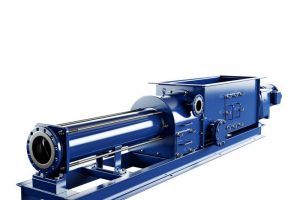
The Seepex D range is modular so it can be scaled up or down, and can be specified to handle extremely viscous products, tailored for hygienic or industrial applications, or be made from chemical-compatible materials, depending on requirements.
Industry 4.0
Seepex’s range of PC dosing pumps includes a Smart Dosing Pump (SDP). Users input just one parameter – the proportional flow ratio – and the pump, featuring an integrated PLC monitor, will make any necessary adjustments automatically. Once set, the flow rate is monitored and controlled by the pump drive, which adapts to variations in operating conditions to ensure accurate, repeatable dosing. Dry running and over-pressure sensors feed back to the drive to protect the pump from damage, helping to increase service intervals and product lifespan.
Easy to operate, the SDP comprises a PC pump with an intelligent inverter drive which is programmed either locally via an HMI or centrally via a fieldbus interface. It can also be controlled via analogue/digital I/Os, locally or remotely by a PLC. It provides the benefits of a PC dosing pump with enhanced control options, future-proofing the dosing system.
Sweet success
At Heineken in Hereford diaphragm pumps were used to dose acids, sweeteners and colours into cider, but were difficult to maintain and recalibrate, Heineken turned to Seepex, who recommended hygienic PC dosing pumps to deliver ingredients – even those with a high viscosity – directly into the product pipeline.
The PC pumps have eliminated problems caused by sticking ball valves and high maintenance requirements. Heineken has found the flow calibration simple and changes to the flow easy to make. Labour costs on maintenance and calibration have been reduced, downtime is lower, and spares costs have dropped. Dosing control and accuracy have improved such that Heineken has since replaced all its diaphragm pumps with Seepex hygienic PC pumps.
IPE Newsletter
IPE publishes a weekly eNewsletter, delivering a carefully chosen selection of the latest stories straight to your inbox.
Subscribe here