

The risks of delaying racking repairs
Repairs to damaged racking may be sidelined amid more pressing business priorities, but even minor damage can significantly reduce load capacity and increase the risk of collapse, explains SEMA
IT IS easy for pallet racking to become part of the background, as warehouse owners and managers navigate competing operational demands. But here is the problem: in a busy warehouse environment, your racking is susceptible to damage from forklift trucks and other mechanical handling equipment. And what happens next is critical.
The dangers posed by damaged racking
SEMA regularly hears the following from warehouse owners and managers: “We know the racking is damaged, but the repairs are expensive so we’re waiting. The racking’s still holding the stock just as it did before. In fact, it’s been like that for months and nothing bad has happened.” But it’s this mindset that creates a dangerous gap in warehouse safety.
Racking is not a fixed structure. It is a structural system engineered to very specific tolerances. Once compromised through damage, even fractionally, the way it distributes load changes.
Metal that has been bent once is more vulnerable. Connections that have been stressed can loosen further. That damage has weakened the racking which impacts on its structural stability. Even small issues can significantly reduce load capacity of the structure.
Put simply, you increase the chance of that racking collapsing. If this happens your business is potentially facing the consequences of stock loss, insurance complications, injury to employees and HSE enforcements.
How to know if the damage needs urgent repair
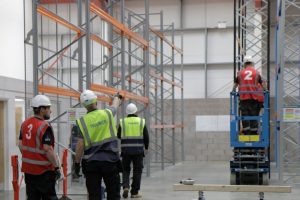
Checking for problems on racking should be a continuous process. You should have a Person Responsible for Racking Safety (PRRS) in place who is responsible for overseeing the safety of the structure and checking inspections and repairs are carried out. Trained members of your team should conduct regular Visual Inspections which form part of your inspection process alongside the final stage, an Expert Inspection by a qualified professional.
These inspections will be looking for visible damage such as dents or creases on the uprights, missing levelling plates or shims and issues with the baseplate and floor fixings.
Once the problem has been found you need to categorise the level of damage. This helps you to prioritise repairs and timescales for completing the work.
- Red risk identifies high levels of damage and pallet racking should be immediately offloaded and put out of use.
- An Amber risk indicates where damage is sufficiently severe to warrant remedial work but does not require immediate offloading. The pallet positions in this area must then be emptied, and only refilled once repairs are complete. Racking repairs have to be carried out within four weeks, or an Amber risk item automatically becomes a Red risk.
- In Green areas damage falls within SEMA limits but recorded for further consideration at the next racking inspection. Green does not mean the damage is acceptable and you should not ignore it.
If your team are not prepared for the Visual Inspections, they should attend a course such as SEMA’s Rack Safety Awareness training. The course instructs on recognising the different types of damage on racking and how to conduct an inspection.
In-house repair risks
There is an obvious business case for warehouse managers to conduct in-house repairs, after all, it saves on the cost of calling out a professional company. However, your team should not undertake repairs unless they’ve been trained in racking installations with the knowledge and skills required to undertake the work.
A racking installer training course such as SEIRS will instruct them on the correct way to work on racking so that it meets the design requirements and, most importantly, permitted repair work under SEMA guidance.
Through training, the team repairing your racking will be clear on acceptable and prohibited repairs in line with SEMA standards. For example, SEMA does not recommend straightening damaged uprights with hydraulic rams, as highlighted in Technical Bulletin No. 04, because the steel may already have been weakened. Attempting to “pop” it back into place might make your racking look temporarily symmetrical, but it doesn’t recreate its original load capacity.
A trained installer will also understand the importance of only altering or replacing components with approved replacement parts. Any repairs not using manufacturer approved parts or non-qualified labour is likely to void your insurance in the event of a serious incident.
What to look for in a racking repair company
If you need a company to carry out the repair work, you should always check three key areas:
- Trained installers: ask to see evidence that the installer has received SEIRS training which proves they are working to SEMA standards.
- Compatible parts: ensure the qualified person is using components that are specifically approved by the original manufacturer. Third-party parts can compromise the safety of the racking and invalidate your warranty, leaving you responsible should the system fail afterwards.
- Manufacturer approved: to protect the integrity of their equipment, some manufacturers may require only using companies approved by them, otherwise it could invalidate your warranty. For example, some SEMA Approved Manufacturers approve SEMA Approved Members to undertake work on their behalf.
These are important steps to check. If something goes wrong later, responsibility may ultimately sit with the duty holder.
Why racking repairs shouldn’t be overlooked
Amid demands such as tight order deadlines, staffing challenges, and managing a logistically complex operation, warehouse racking repairs may not immediately appear a priority, but they are one of the most important safety decisions you will make. Make inspections routine, keep accurate records and ensure all repairs are carried out by SEIRS-qualified installers using approved parts and you will greatly improve the safety of your warehouse.
For further advice download SEMA’s Stay Racking Safe Guide here: sema.org.uk/warehouse-racking-safety-guide
For more information:
Tel: +44 (0)1543 278489
Related posts

IPE Newsletter
IPE publishes a weekly eNewsletter, delivering a carefully chosen selection of the latest stories straight to your inbox.
Subscribe here