

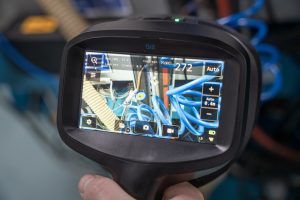
Thermal imagers: Smarter by design
Several technological milestones in the development of thermal imaging have prompted its transition from specialist detection tool to one optimised for mainstream use. These advances have resulted in the technology becoming a primary method for electro-mechanical fault detection and for investigating the causes of energy loss. Andrew Baker – sales director North Europe – FLIR Systems, explains more
The popularity of thermal imaging has fuelled take-up which in turn has resulted in falling camera costs. This affordability, however, has not resulted in dumbed-down functionality – quite the opposite in fact. With every new generation, infrared cameras are becoming increasingly smart.
The introduction of the uncooled detector was perhaps the most significant breakthrough in the commercialisation of thermal imaging. Historically, a Sterling cooler was central to the workings of thermal imaging cameras. This added to the cost, complexity and high maintenance requirements of the technology.
Another important move was the availability of high resolution detectors for industrial applications. For the first time maintenance engineers could see the small thermal differences with the clarity only previously expected from a scientific infrared camera.
Along the way, numerous other hardware advances have contributed to the growing popularity of this versatile technology and these have been matched by the parallel development of analysis and reporting software whose cost has also dropped dramatically in recent years.
Latest milestone
To assist with image interpretation, a digital camera has also become a standard feature on many models above the low-end troubleshooting range. It allows a visual image to be taken alongside its thermal counterpart to provide definition and put it into context. But this 'manual' comparison is now fast becoming old technology as software developments have introduced a much smarter approach.
This advancement is based on multi-spectral imaging which, as its name suggests, looks at an image across a wider spectrum, not just in the infrared or visible light wavelengths specifically. It is a technology that is widely used in the scientific field but has now also been applied to industrial thermal imaging.
The development, which is brand-specific, instantaneously generates a definitive, all-in-one thermal picture that provides as much detail as possible to make a quick diagnosis of the problem. Thermal, visual and multi-spectral images are saved simultaneously with a single click of a button for review on the camera's touch screen, on a pc, mobile device, smartphone or for inclusion in a written report.
No need for visual
Key visual light details such as numbers, labels, signage and structural features can easily get lost in a regular thermal image which only displays heat signatures. Areas displaying small temperature differences are often hazy as a result as the colour contrast is minimal. To overcome this limitation a corresponding visual has provided the detail but, with the introduction of multi-spectral imaging, this is negated.
The software tool captures visual data from the built-in digital camera and radiometric data from the thermal camera. It then analyses the image and superimposes key elements from the visual image as a high-contrast 'skeleton' on the thermal output. This all happens in real time and without compromising temperature measurement, accuracy or minimising its visibility. The result is an image showing unprecedented detail.
Comparative performance
Previous generations of thermal imaging cameras have featured ways to blend, overlay or fuse a portion of a thermal image into a visible light picture. These modes have only provided a partial solution. They also took longer to apply and interpret and had a tendency to limit or obscure the thermal view of the scene.
The multi-spectral imaging development is a completely different technology. It embosses digital camera detail on the video and stills, providing better visible results without diluting the thermal image. Orientation of the target is easy, reports are clutter-free and all of these elements contribute to faster and more efficient inspection. This, in turn, has had a real impact on overall plant efficiency and costs of operation.
Related posts

IPE Newsletter
IPE publishes a weekly eNewsletter, delivering a carefully chosen selection of the latest stories straight to your inbox.
Subscribe here