

Thermal imaging improves inspection at Chinese renewable project
Infrared thermal imaging is helping operators at an 80GW hydro-wind-solar base in southwest China identify module and equipment faults before they escalate
CHINA NOW holds more than 40% of global photovoltaic (PV) capacity, but this rapid expansion has brought with it operational challenges. Intermittency, output fluctuations and legacy operations and maintenance (O&M) inefficiencies all threaten to constrain the sector's development.
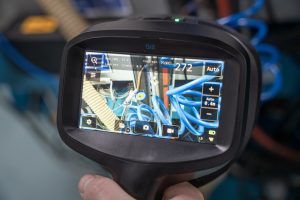
At an 80GW integrated hydro-wind-solar base in southwest China – a development zone combining multiple generation types on a single coordinated site – the O&M team turned to infrared thermal imaging to address these issues, adopting a Flir T540 professional infrared camera paired with a FlexView dual field-of-view lens.
The dual FOV lens allows instant switching between a 24° standard field of view and a 14° telephoto field of view without manual lens replacement, enabling faster fault localisation across large installations. Working from on-site conditions, the team developed what it describes as a proactive prevention strategy, balancing inspection efficiency against accuracy.
Detecting module faults before failure
Shading, physical damage and diode failure all present as hot spots with a temperature differential greater than 5°C. Identifying these zones allows repairs within 24 hours, preventing power losses of between 20% and 50%.
More subtle defects are harder to catch. Micro-cracks and cold-solder joints produce linear or mesh-like low-temperature patterns with a differential of around 1°C. Capturing these enables repair within 72 hours and extends module lifespan.
Potential induced degradation (PID) produces stripe-shaped high-temperature zones along module edges. Early identification allows resolution within seven days, preventing further degradation.
Protecting critical equipment
Beyond the modules themselves, thermal imaging is used across the installation's supporting infrastructure. Overheating points on inverter and transformer-box heat sinks and terminals can be detected before equipment burns out, improving conversion efficiency by 3% to 5%.
Battery banks are monitored for localised overheating and abnormal temperature rise. Insulated busbars are checked for poor contact and insulation ageing, both of which can lead to short circuits or fire. Abnormal temperature rises in SVG power modules, reactors and cable joints are identified before they cause downtime.
The dual FOV lens also allows operators to detect short circuits while working at a safe distance from live equipment.
Thermal imaging is applied to mechanical components too, where temperature anomalies can reveal deformation or loose fittings, and to transmission lines, where hotspots indicate poor contact or overloading.
For operators managing installations at this scale, integrating technology like the Flir T540 and FlexView is enabling a shift to a proactive prevention model, identifying faults while they remain minor and addressing them within defined windows rather than after failure.
For more information:
Related posts
IPE Newsletter
IPE publishes a weekly eNewsletter, delivering a carefully chosen selection of the latest stories straight to your inbox.
Subscribe here