


From customer request to standard: binder’s 12-pin M8 mating face is now standardised as C-coding
THE REVISED detail specification for M8 circular connectors, DIN EN IEC 61076-2-104 (VDE 0687-76-2-104), has been published and, for the first time, includes C-coding: a 12-pin interface in the M8 format
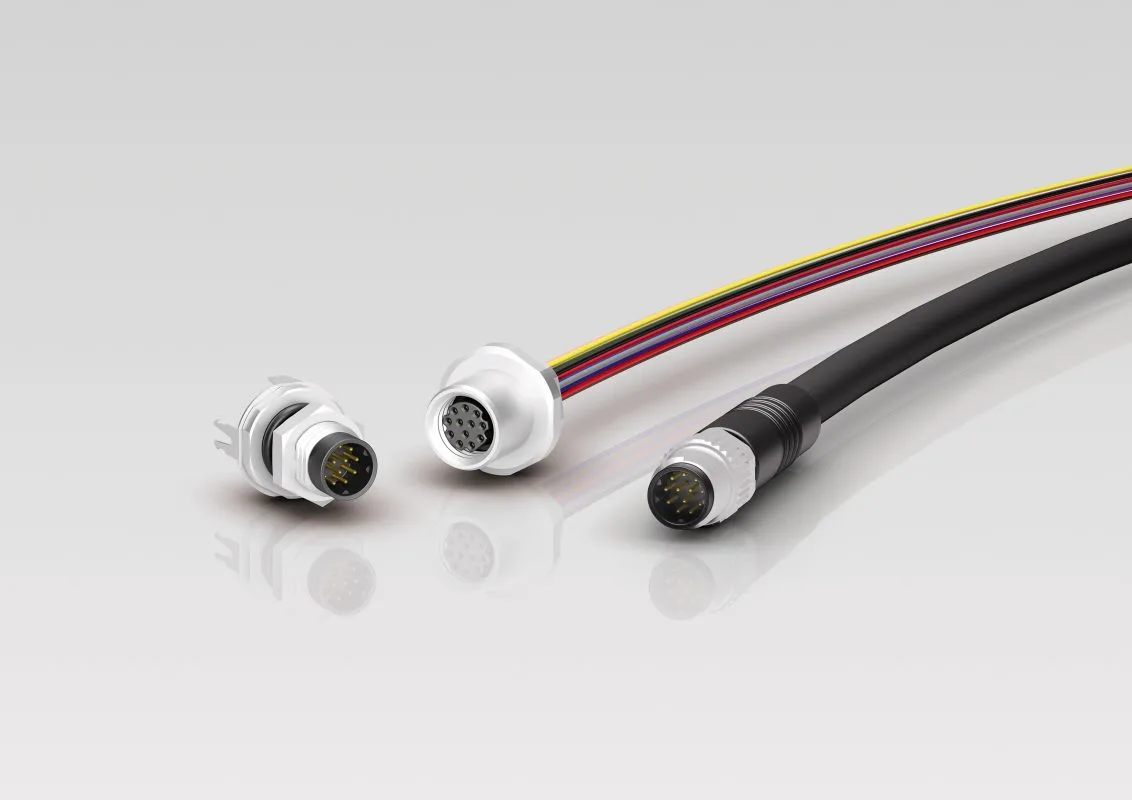
It is based on a mating face that binder launched under its own coding back in 2020. Since then, it has proven itself in the field in length measuring systems, in laboratory automation for environmental analysis and in industrial cameras from leading manufacturers.
It started with a customer request
The development was triggered by a specific customer requirement: a manufacturer of length measuring systems needed more than eight signals for a new generation of devices but, for technical reasons, could not increase the M8 size it had been using. binder recognised the potential and decided to develop a 12-pin M8 mating face and add it to its standard portfolio as a separate coding.
A design challenge with an unusual solution
Twelve contacts on an M8 diameter sounds simple, but it was not. The original plan was a single, larger coding key, as used by other M8 codings. With twelve symmetrically arranged contacts, however, there was no longer room for it. The solution: five small coding keys instead of one large one. They allow the free connector to be oriented securely without bending the contacts, which are only 0.5 millimetres thin, during mating.
The format also called for precision in production. The M8 plastic bodies are fitted with the twelve contacts by hand, which requires a delicate touch and magnifying aids. The panel mount connectors use twelve fine single wires in different colours, arranged in a precisely defined order. A colour template shows employees which wire belongs in which position. The cable connectors are then moulded by machine.
Planning certainty for users
For users, standardisation means one thing above all: planning certainty. The mating face, coding and connection dimensions are now documented independently of the manufacturer. C-coding is therefore no longer a proprietary format, but a regular part of the M8 world alongside the established A and D codings. For binder customers, nothing changes technically: the products remain available as before, now backed by the standard.
Applications
C-coding has been in use in the field since 2020 – including in length measuring systems from leading manufacturers, in laboratory automation for environmental analysis and in industrial cameras from well-known manufacturers. A typical example from conveyor technology illustrates the principle: in a parcel sorting system, four sensor signals, four actuator signals and four additional signals can be routed through a single M8-C interface – turning the 12-pin M8 into a compact interface between field device and decentralised I/O level.
- Displacement and length measuring systems: more than eight signals without switching to M12 – in field use since 2020.
- Laboratory automation: environmental analysis systems with high signal density
- Industrial cameras: compact multifunction interface for image, trigger and status signals
- Conveyor and sorting technology: several field signals from one sensor/actuator module via a single interface
- Robot grippers: sensors, gripping function and diagnostics in minimal installation space
Technical features at a glance
- Design: male and female cable connectors, moulded; panel mount connectors for rear panel mounting
- Interface: M8 C-coded according to DIN EN IEC 61076-2-104, 12-pin
- Locking: Screw locking
- Degree of protection: IP67 when mated and locked
- Electrical ratings: Rated current 1 A; rated voltage 30 V or 32 V depending on version; rated impulse voltage 500 V; overvoltage category II; conductor cross-section 0.09 mm² (AWG 28)
- Environment: Cable connectors -25 °C to +85 °C, panel mount connectors -40 °C to +85 °C; cable fixed -40 °C to +90 °C, cable in motion -25 °C to +90 °C; UL 2238
- Materials: Contacts brass or bronze, gold plated; housing PUR (cable connectors) or brass nickel plated (panel mount connectors); contact body PUR; cable jacket PUR (halogen-free) or PVC
Expert statement
“With the revised standard, the foundation has been laid for consistent mating compatibility across the connector market,” says Guido Werner, product manager at binder. “The future of automation lies, among other things, in miniaturisation, and with our portfolio of smaller sizes such as M5 and M8, we are already very well positioned for this.”
Conclusion
With standardisation, a binder development becomes an industry standard. Users get a 12-pin interface in the compact M8 format that has been proven in the field for six years and is now documented independently of the manufacturer. binder supplies it as male and female cable connectors and as panel mount connectors for rear panel mounting.
www.binder-connector.com/en/products/automation-technology/m8-c
Related posts

IPE Newsletter
IPE publishes a weekly eNewsletter, delivering a carefully chosen selection of the latest stories straight to your inbox.
Subscribe here