

Sandvik Coromant cuts tool adaptor carbon footprint by 90% with new remanufacturing service
Carbide components recovered from used Silent Tools adaptors are returned to service in new tools
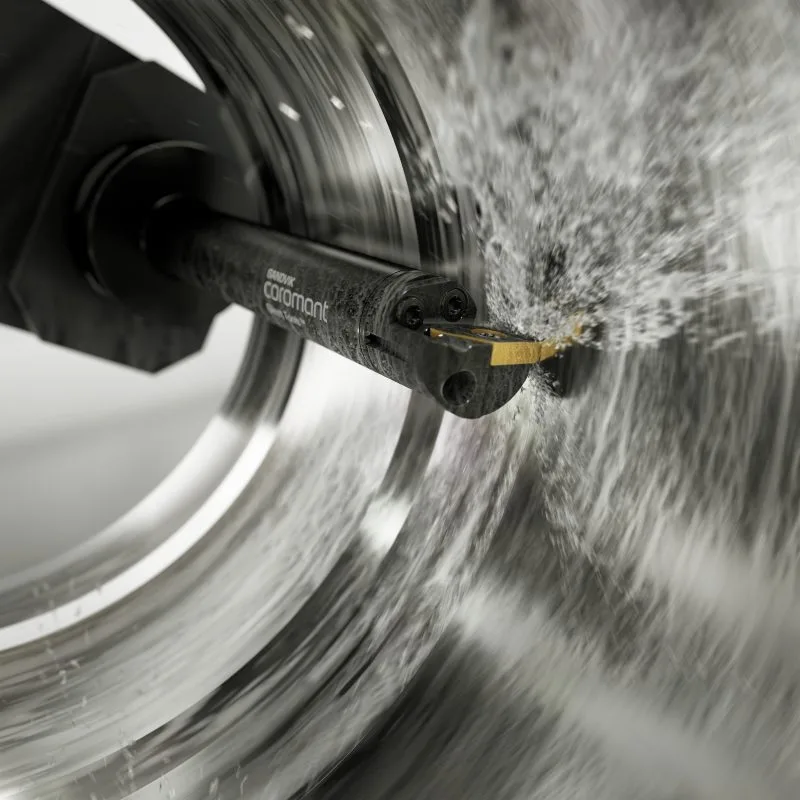
TUNGSTEN IS among the most resource-intensive materials used in metal cutting. In a damped turning adaptor with a carbide reinforced tool body, components containing tungsten account for more than 90% of the tool’s total CO₂ footprint*. With tungsten prices rising, scarce material availability, and manufacturers under increasing pressure to demonstrate circularity, the components inside a used tool hold value that has traditionally been lost when the complete tool went to recycling. Sandvik Coromant is introducing remanufactured Silent Tools vibration-damping turning adaptors, an offer that recovers those components and returns them to service in new tools.
The starting point came from a customer. Approaching the end of a Silent Tools bar’s service life, they observed that significant value remained in its components and asked whether a better alternative existed than discarding the complete tool. That question became the basis for the new remanufacturing process.
.The carbide reinforced rings in a Silent Tools adaptor are among its most valuable and resource-intensive components, and they are frequently still in good condition when the adaptor itself needs replacing. Under conventional practice the entire tool went to recycling regardless. In the remanufacturing process, returned adaptors are disassembled and the rings are inspected, cleaned and quality checked before being reused in new tools. Reusing components in this way reduces demand for new raw material, removes a substantial amount of processing, and lowers CO2 emissions accordingly.
Material in the metal cutting industry conventionally moves in one direction, from production unit to customer. Remanufacturing requires moving to a circular business model.
“What makes this possible today is that we have developed a new reverse flow,” said Ella Berglund, global supply chain planner at Sandvik Coromant, who led the pilot project. “Valuable components flow back from the customer into a circular manufacturing process where they can be reused in future tools. Being part of turning a customer idea into a global offering has been one of the most rewarding parts of the project.”
The environmental case is measurable. Switching the tungsten components to recycled material reduces the CO₂ footprint of the adaptor by 40%, while reusing them takes that reduction up to 90%.
A remanufactured adaptor delivers the same quality and performance as a new one and carries the same guarantees. The offer currently covers carbide reinforced Silent Tools adaptors above 25 mm or 1 inch, including standard, special and sensor-equipped Silent Tools Plus versions.
“The tool that comes back has the same guarantee and the same function as a new one,” said Åke Axner, global product manager for Silent Tools at Sandvik Coromant. “That was the condition for doing this at all. A more sustainable option is only worth having if customers do not have to give anything up to get it.”
For most customers the argument is commercial as well as environmental. A remanufactured adaptor costs less than a new one, and customers who return a used adaptor also receive a sustainability bonus, calculated on the diameter of the tool sent back and applied to the price of the replacement. Returning a tool that would otherwise have gone to recycling therefore lowers the cost of the next one, and with tungsten prices rising and material availability tightening, that argument is becoming stronger rather than weaker.
The process was also designed to place as little administrative burden as possible on the customer. A customer with an adaptor they no longer need requests a quotation through their usual Sandvik Coromant contact, and the replacement tool does not need to match the dimensions or specification of the one returned, which allows manufacturers to align the tool that comes back with current production requirements. Once the order is placed, the customer ships the used adaptor to the nearest Sandvik Coromant production unit and that is it.
After that, Sandvik Coromant manages internal shipping, disassembly, quality control, manufacturing and delivery. If there are not enough rings in the right dimensions, new rings are added. Customers who return an adaptor also receive a Sustainability bonus on the replacement tool, calculated on the diameter of the tool sent back.
The carbide reinforced rings are the components covered today, and the scope of the process may be widened to include further components in the future.
“It is easy to talk about circularity in theory,” Berglund continued. “Seeing returned tools come back into the process and become part of a new tool makes the concept very tangible.”
The offer is available in Europe, USA and Canada, with further markets to follow. Availability and the return process vary by market, and customers are advised to contact their local Sandvik Coromant representative.
IPE Newsletter
IPE publishes a weekly eNewsletter, delivering a carefully chosen selection of the latest stories straight to your inbox.
Subscribe here