

2010 vision
With coding, marking and labelling an essential component
of modern production technology, industrial vision-based
code readers have an important role to play.Don Braggins
of UKIVA explains
From processing to packagin
With coding, marking and labelling an essential component
of modern production technology, industrial vision-based
code readers have an important role to play.Don Braggins
of UKIVA explains
From processing to packaging through to
warehousing, barcode reading is used in
applications as varied as verifying
product IDs and automatic picking of products
in a warehouse. Correct packaging labelling is
critical for consumer safety, especially in the
food, beverage, pharmaceutical and medical
industries. In addition, ‘mark and read’
applications are used for product
identification and traceability, especially in
safety-critical industries such as aerospace and
automotive. Coding and labelling usually takes
the form of alphanumeric codes, barcodes
and the more recently introduced 2D codes.
Vision-based
technology
Industrial vision code-readers
provide an alternative to the
more conventional laser
scanners. A 1D bar code has
a ‘check sum’ built in so that
a laser-scanning type of
reader can tell if there is an
error in reading it, but can
do nothing about it except
to say ‘unreadable’. A vision
system has a better chance
of reading a 1D code
because if any part of a bar
is intact, it can use that
information. Vision-based
readers tend to be used in circumstances
where it is simply not acceptable to receive a
‘cannot read – check sum not correct’ from a
laser scanner. Consider packages coming down
a conveyor at constant speed with no facility
for offloading those whose code cannot be
read.Vision systems are more likely to ‘deduce’
the meaning of the code, so using a slightly
more expensive vision system instead of a laser
scanner might avoid the cost of building in a
diversion line for packages too difficult to read.
Vision-based code readers fall into two
basic categories: Dedicated code readers,
both for 1D and 2D code reading, and
systems based on industrial cameras. All face
the same challenges: Random code or label
positioning or orientation, abnormal codes
or characters, damage to the code, viewing
conditions, interface to the rest of the
process, and speed of measurement.
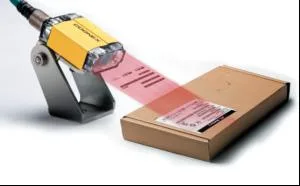
Dedicated vision-based readers
Such systems generally feature an integral
illumination source and lens and an image of
the code is produced using a CCD sensor.
Available in fixed mount and handheld
versions, they feature onboard software to
process the image and read the code.
For 1D code readers, the challenge is in
developing robust reading algorithms that
produce reliable results even under non-ideal
conditions such as those illustrated. 1D codes
are less robust than 2D codes and visionbased
readers are more effective than laser
scanners in reading low contrast or damaged
codes or those distorted by severe perspective.
Reading algorithms have been developed
which can handle extreme variations in
contrast, blur, damage, voids, specularity,
resolution, quiet zone violations (which can
occur when codes are printed close to the
edge of a label) and perspective distortion.
Since these readers generate an actual image
of the code, it is possible to archive images of
read failures and download them to a PC to
diagnose the root cause of a problem. The
performance of individual readers varies from
manufacturer to manufacturer, but in addition
to their capability to read challenging codes,
consideration should be given to the speed at
which printed codes can be read. Some
readers offer the flexibility to upgrade
software for 2D code reading. Readers are
available with a variety of interfaces, such as
Ethernet/IP and USB, which is important for
control, data transfer and integration.
Complete vision systems
A high degree of code reading flexibility is
offered by using a fully functional industrial
vision system equipped with code reading
and optical character recognition software.
These differ from the dedicated code readers
in that they feature a full camera and lens,
often with an external illumination source.
Images of the code are recorded for
subsequent processing and measurement.
There are a number of options. The camera
may be connected to a PC where the
processing is carried out, or smart cameras
can be used. These self-contained, standalone
vision systems have built-in image processing
capabilities. A third option is the compact
vision system, where all processing power is
contained in a DIN mountable enclosure. This
lets multiple cameras be connected to a single
processing unit. A key benefit of these powerful
vision systems is their flexibility, since they can
carry out a host of inspection tasks as well as
reading the code.Overview capabilities include
checking that the proper label is on the
package, that the label is correctly positioned
and that the placement angle is within set
limits, as well as looking for consistency in
colours and logo positioning for brand image
purposes. Software can also check for flags,
tears and missing parts of the label as well as
for defects such as smears, contamination
and splatters.With a wide choice of camera
types and connectivity standards available,
industrial vision systems can be chosen for a
huge range of industrial environments.
The author thanks UKIVA members Alrad
Imaging, Cognex UK and Stemmer Imaging
for their contributions to this article.
IPE Newsletter
IPE publishes a weekly eNewsletter, delivering a carefully chosen selection of the latest stories straight to your inbox.
Subscribe here