

Adhesive solution to vibration issues
Bob Orme, a senior technology specialist at
Henkel, manufacturer of Loctite brand products,
explains why he believes adhesives may be the
answer for maintenance engineers dealing with
vibration issues
Vibration has c
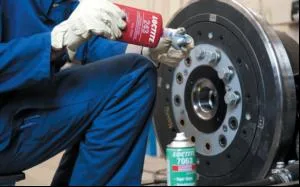
Bob Orme, a senior technology specialist at
Henkel, manufacturer of Loctite brand products,
explains why he believes adhesives may be the
answer for maintenance engineers dealing with
vibration issues
Vibration has caused bolts to
work loose since threaded
joints first came into
existence.Many and varied methods
of resolving the problem have been
tried and a successful method has
centred on the application of
adhesives.
Back in 1953 Dr Vernon Krieble,
pioneer of Loctite adhesives,
discovered a way to lock and seal a
threaded component. He was able to
fulfil a need within industry – that of
securing a screw in a carburettor in
such a way that it could withstand
severe vibration. Dr Krieble was very
successful in his experiments – so
much so that anaerobic adhesives
were quickly established across a
variety of industries as a trusted
method of protecting parts against
the potentially disastrous effects of
vibration.
Why bolts?
A bolt provides a means of
locating components within an
assembly.
It creates a clamp force.
It allows a joint to be readily
disassembled and reused (unlike
technologies such as welding and
riveting).
When it comes to producing a
vibration-proof assembly, the last two
points are the relevant factors.
Creating tension
As already stated, threaded fasteners
provide a clamping force. After the
tightening process of a threaded
assembly has been concluded, the
clamp load is retained by the pre-load
of the bolt. Yet, the absence of a
locking ‘mechanism’, can lead to the
loosening of the fastener, when
shock, alternating loads, thermal
changes and vibration are introduced
into the situation. And it is this
loosening that results in the clamping
load being compromised.
Loss of clamp load means there is
a good chance that machinery will
fail – with all the aggravation that any
engineer would want to avoid.
A reliable solution can be found in
the employment of engineering
adhesives, as the following example
illustrates.
Shocking results
An independent assessor used a
transverse shock test machine that
enabled anaerobic threadlockers,
spring washers, patch bolts, distorted
lock nuts and nylon ring nuts to be
compared under controlled
conditions.
The test involved assembling a
3/8in, 16-grade bolt in the machine
and then tightening it to a controlled
tension. Once that was done, air
hammers were activated and the bolt
tension plotted against time.
As the accompanying graph
reveals, the adhesive offered better
protection against the bolt working
loose than any of the other methods.
For example, it didn’t take long
before the tension in the bolt was lost
when secured by the nylon ring nut.
However, the adhesive-treated
assembly proved permanently secure
and the tension in the bolt was
maintained.
Addressing adhesives
Engineering adhesives – especially,
anaerobic products – provide an
efficient vibration-proof system.
These single part adhesives cure in
the absence of air when in contact
with a metal. (Air is generally
excluded from the joint when two
mating surfaces – whether threaded
or not – are brought together.)
Further, these adhesives fill all the
spaces between the threads of a bolt
and a nut, sealing the assembly at the
same time.
Adhesives offer an advanced
vibration-proof system when it
comes to locking joints. There is a
cost-saving implication, too.
Through the use of adhesives, any
fastener can become a locking
fastener – without the need to
maintain an inventory of varying
sized locking aids to suit different
applications.
I believe engineering adhesives
present really good news for
engineers who need to ensure they
produce and maintain a vibrationproof
assembly.
IPE Newsletter
IPE publishes a weekly eNewsletter, delivering a carefully chosen selection of the latest stories straight to your inbox.
Subscribe here